- Family owned since 2011
How to Lower Heating Bill Costs With Fixes That Actually Pay Back
2,000+
Five-Star Reviews
5,000+
Projects Completed
15 Years
In Business
24/7
Emergency Response
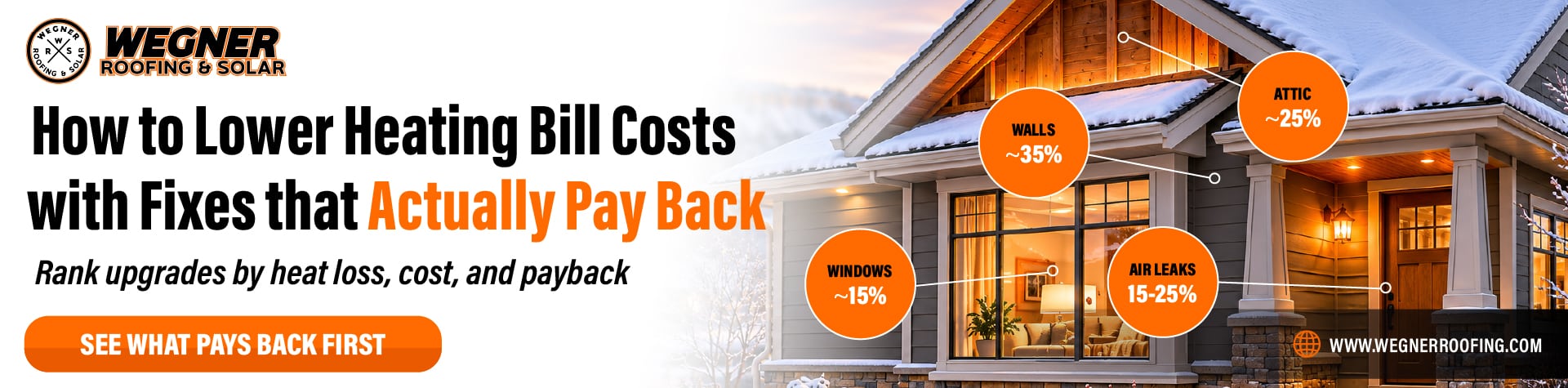
Knowing how to lower heating bill costs starts with understanding exactly where your home is leaking heat before spending a dollar on any fix. Your attic, walls, windows, and air barriers work together as a single thermal system, and a weak point in any one of them forces your furnace to run harder through every January night in the Yellowstone Valley. With MDU residential gas rates up 35.7% since November 2025, that extra furnace runtime now costs measurably more than it did last season.
This breakdown covers where older Billings homes lose the most heat, which repairs deliver the fastest payback, and what the 2026 federal tax credit changes mean for your project budget. If you want a professional assessment of your specific home before committing to any upgrade, connect with the Wegner Roofing & Solar team for a free local estimate and get clarity on where to start. Reach out to us today!
The Real Numbers Behind a Rising Winter Gas Bill
MDU Resources Group, the primary natural gas utility for Billings residential customers, received Montana PSC approval for a rate increase with final rates taking full effect on November 1, 2025. The average monthly residential gas bill moved from $44.61 to $60.54, a jump of 35.7% in a single rate cycle.
Put that into seasonal terms: a household that spent approximately $535 on gas from November through April under the prior rate structure is now budgeting closer to $726 for the same six-month heating season, before accounting for any colder-than-normal months or increased consumption. The Yellowstone Valley averages a January low of 14 degrees Fahrenheit, and wind loading along the Rimrocks corridor strips additional heat from exterior wall surfaces faster than still-air thermal models predict.
How to Read the Therm Line on Your Bill, Not Just the Total
Most homeowners look at the dollar total on their MDU statement and stop reading. The more diagnostic number is therms consumed per day, which MDU bills display in the usage history section.
A well-insulated 1,800-square-foot home in Climate Zone 6B should consume approximately 6 to 8 therms per day during a sustained cold snap below 20 degrees Fahrenheit. A comparable home with single-pane windows, R-11 attic insulation, and no air sealing can consume 12 to 16 therms per day under identical outdoor conditions. If your daily therm usage increased from last winter to this one without a change in household size or thermostat settings, your home’s thermal envelope has degraded. The rate went up, but so did your consumption.
Where an Older House Loses Heat, Ranked by Impact
Before pricing out upgrades, you need an accurate diagnosis of how heat actually escapes your home’s thermal envelope. The most important detail that generic energy-saving advice consistently misses is that not all heat loss is equal, and the sequence in which you address each pathway determines how much money you actually recover.
Department of Energy building science data maps heat loss across five pathways in pre-1980 construction. Understanding those proportions is the single biggest advantage a homeowner has when allocating a repair budget.
Heat Loss Pathway | Share of Total Loss (Pre-1980 Home) | Typical Installed Cost | Simple Payback |
Ceiling / Attic | ~25% | $1,500 to $3,500 | 4 to 7 years |
Walls (framing + insulation gaps) | ~35% | $4,000 to $12,000 | 7 to 12 years |
Windows and Doors | ~15% | $400 to $1,200 per unit | 8 to 15 years |
Floors over Crawlspaces | ~10 to 15% | $1,000 to $3,000 | 5 to 8 years |
Air Infiltration (gaps, penetrations) | ~15 to 25% | $300 to $1,500 | 1 to 3 years |
Walls and ceilings together account for roughly 60% of total heat loss. Air infiltration adds another 15 to 25%. Windows account for approximately 15%, the smallest share of the four primary pathways. This does not mean windows are unimportant. It means the order you address them determines whether you get 15% of the solution first or 60%.
The Attic Is the Biggest Leak You Are Not Thinking About
Across the South Side bungalow stock and the craftsman-era homes near the downtown core, attic insulation was commonly installed to R-11 during original construction. The DOE’s current minimum recommendation for Climate Zone 6B, which covers Billings and surrounding communities including Laurel and Lockwood, is R-49 to R-60.
An attic at R-11 is operating at roughly 22% of the thermal resistance this climate demands. Upgrading to blown-in fiberglass or cellulose at R-49 produces a verified 15 to 25% reduction in annual heating and cooling costs, per Energy Star modeling for Zone 6B retrofit projects. That makes attic insulation the highest-ROI action available for the majority of pre-1980 homes in this region.
Walls and the Air Gap Behind Your Siding
The Heights neighborhood and the 1960s-to-1980s ramblers east of Main Street share a common construction detail: 2×4 framing with R-13 batt insulation, no continuous exterior insulation layer, and original cladding installed directly over 15-pound felt paper. There is no thermal break between the stud framing and the exterior surface.
This matters because wood framing has an R-value of approximately R-1.25 per inch. A 3.5-inch stud carries only R-4.37 in a wall cavity rated R-13 in the insulation batt. Whole-wall R-value for a typical 1970s exterior wall in this area, once framing, sheathing, and original cladding are factored together, lands between R-8 and R-10. That is less than half of what current energy code requires for new construction in this climate zone.
Windows: Important, But Not the Whole Story
Single-pane windows carry a center-of-glass R-value of approximately R-0.9. A code-compliant double-pane low-e window installed today carries R-3.2 to R-5.0. That is a meaningful thermal improvement, and in north-facing or northwest-facing rooms, the comfort difference is perceptible before any energy savings are calculated.
The financial case for window replacement is strongest when frames are visibly deteriorated, glazing seals have failed (fogging between panes indicates a broken argon seal), or single-pane glazing is installed in rooms with extended cold-side exposure. See the full scope of what replacement involves on the window installation and replacement services page for Billings, MT.
Drafts You Can Feel vs. the Leaks You Cannot Locate
Homeowners near Lockwood and the Heights deal with a wind-loading pattern that drives air infiltration differently from still-air climates. When a Chinook event brings a 30 to 40 degree temperature swing in under 12 hours, wood framing cycles through rapid thermal expansion and contraction. Over decades, this opens gaps at top plates, around electrical penetrations, and at the intersection of interior partition walls with the exterior ceiling plane.
These gaps are invisible without a blower door test but can account for 15 to 25% of a home’s total heat loss. The freeze-thaw and wind stress patterns specific to Chinook season accelerate this degradation in pre-1980 homes at a rate measurably higher than post-2000 construction.
How to Lower Heating Bill Costs: The 4-Step Retrofit Sequence
Once you know where your home is leaking heat, the next step is executing the repairs in the right order. This four-step retrofit sequence follows DOE cold-climate guidance, adjusted for the specific housing stock, climate zone, and utility cost structure in this part of Montana, so you never trap moisture or pay for low-ROI upgrades first.
Step 1: Air Seal Before You Add Anything Else
Air sealing a 1,500 to 2,200 square foot home costs approximately $300 to $1,500 with a professional contractor. The verified return is a 15 to 25% reduction in heating costs, per Energy Star Zone 6B retrofit data. On a per-dollar basis, air sealing produces the highest ROI of any energy improvement available to a homeowner at this stage.
Primary target locations: top-plate penetrations in the attic floor, recessed light housings, plumbing chases, and where interior partition framing meets the exterior sheathing.
Critical sequence note: Do not install attic insulation before completing air sealing. Adding insulation over unaddressed air pathways traps moisture in the assembly and can reduce insulation effectiveness by 30 to 40%.
Step 2: Attic Insulation, the Fastest Payback in Cold Climates
After air sealing, bring the attic assembly to a minimum R-49. For a 1,500 square foot home in this area, this typically costs $1,800 to $2,800 installed. At current MDU rates, annual heating savings run $180 to $350. Simple payback is 6 to 10 years; factoring in ongoing rate escalation shortens effective payback to 4 to 7 years.
Step 3: Window Replacement, When It Makes Sense
Window replacement delivers comfort improvements that insulation alone cannot provide. Radiant cold from a single-pane window can drop the perceived temperature of a room by 4 to 6 degrees Fahrenheit even when the thermostat is satisfied. North-facing rooms in older South Side homes are disproportionately affected, and that is a legitimate reason to prioritize windows even where the pure energy ROI argument is narrow.
For a Billings home replacing 8 to 12 windows, total installed costs typically run $8,000 to $18,000 depending on window line and frame material. Annual energy savings from upgrading single-pane to double-pane low-e units average $200 to $400 for a mid-size home. Energy-only payback runs 20 to 40 years; combined with comfort gains, reduced HVAC wear, and home value improvement, effective payback shortens considerably.
Review the full range of available window systems at Wegner’s window installation and replacement services in Billings, MT.
Step 4: Insulated Siding, the Wall Upgrade That Does Double Duty
Insulated siding addresses the one problem that air sealing and attic insulation cannot solve: the thermal bridging running through every stud in your exterior walls. The next section explains exactly what each siding option delivers in measurable R-value terms.

Does New Siding Actually Warm a House?
It depends entirely on which type you choose. Standard vinyl siding carries an R-value of R-0.6 to R-1.0. It updates appearance but adds negligible thermal resistance to the existing wall assembly.
Standard Vinyl vs. Insulated Vinyl: The R-Value Difference
Insulated vinyl siding bonds an expanded polystyrene (EPS) foam backer to the back of each panel. That backer adds R-2.0 to R-3.8 of continuous insulation across the full wall surface, including over stud locations where thermal bridging is most active.
For a 1970s rambler in the Heights with a whole-wall R-value of R-8 to R-10, insulated vinyl brings the effective assembly to R-10 to R-14, a 25 to 40% improvement in wall thermal resistance over what is currently there.
Fiber Cement and Rigid Foam Sheathing: The Bigger Play for Older Walls
The higher-performance option for homes in Zone 6B is fiber cement siding installed over a layer of rigid polyisocyanurate (polyiso) or XPS foam sheathing. A 1-inch polyiso layer adds R-6.0 to R-6.5 of continuous insulation. A 2-inch layer brings the wall assembly to R-12 to R-15 continuous, which combined with existing cavity insulation can push whole-wall performance to R-20 or better.
Homes along the Rimrock Road corridor and near Laurel Road that face sustained northwest wind loading in January benefit measurably from continuous exterior insulation. This is the only wall-level upgrade that brings older assemblies close to current new-construction thermal standards.
Siding Type | R-Value Added | Best Application | Avg. Installed Cost Per Sq Ft |
Standard Vinyl | R-0.6 to R-1.0 | Aesthetics refresh only | $4 to $7 |
Insulated Vinyl (EPS backer) | R-2.0 to R-3.8 | Thermal upgrade, budget-conscious | $6 to $10 |
Fiber Cement (no foam layer) | R-0.4 to R-0.6 | Durability and appearance | $8 to $13 |
Fiber Cement + 1″ Polyiso | R-6.0 to R-7.0 | Maximum cold-climate wall performance | $12 to $18 |
Get a local siding assessment from Billings siding contractors experienced in both insulated vinyl and fiber cement systems for this climate zone.
The 2026 Tax Credit Reality Check: No Federal Credit This Year
This is where most homeowners are receiving outdated information heading into the 2026 heating season, and the financial impact is real.
Why the 25C Credit Is Gone and Who Told You Otherwise
The Section 25C Energy Efficient Home Improvement Credit, part of the Inflation Reduction Act, allowed homeowners to claim 30% back on qualifying window replacements (up to $600 per year) and insulation upgrades (up to $1,200 per year). The One Big Beautiful Budget Act (OBBBA), signed as Public Law 119-21, allowed this credit to expire effective December 31, 2025.
For projects placed in service on or after January 1, 2026, the 25C credit does not exist. Any contractor website, utility program brochure, or blog post still displaying the 30% window or insulation tax credit is operating on expired information. Budget your project without it.
Montana and Utility Rebate Programs That Still Exist
Two channels remain worth verifying before you schedule work:
MDU Residential Efficiency Rebates: MDU Resources Group has historically administered rebate programs for qualifying insulation and efficiency upgrades in Montana. Program terms, rebate amounts, and availability change annually. Call the MDU customer service number printed on your gas bill to confirm what is currently active before scheduling any work.
Montana DEQ Weatherization Assistance Program: Income-qualified homeowners may be eligible for no-cost air sealing and insulation services through the Low Income Weatherization Assistance Program, administered by the Montana Department of Environmental Quality through regional community action agencies. In the Billings area, contact the South Central Community Action Partnership to confirm current income thresholds and program availability.
One related note: pre-1980 homes with unaddressed attic air sealing deficiencies frequently develop ice dam problems during Chinook thaw cycles, compounding energy loss with structural damage. The ice dam patterns in older Billings homes resource explains that connection and when it becomes a repair-level issue.
Frequently Asked Questions
If you are planning exterior or insulation upgrades before the next cold snap, here are the most common questions homeowners ask about tightening their home’s thermal envelope.
How can I lower my heating bill in an old house?
The fastest way to learn how to lower heating bill expenses in an older home is to combine professional air sealing with attic insulation upgrades. Together, these two steps typically reduce annual heating costs by 20 to 35% and carry the shortest payback period of any available home energy improvement. Window replacement and insulated siding address the remaining thermal gaps.
Where does an older house lose the most heat?
Pre-1980 homes lose the largest share of heat through walls (approximately 35%) and the ceiling or attic (approximately 25%), based on DOE building science data. Air infiltration through unsealed penetrations adds another 15 to 25%. Windows account for roughly 15% of total heat loss.
What should I fix first: windows, attic, or walls?
Address air infiltration (air sealing) first, then upgrade your attic insulation, followed by windows and insulated wall siding. This follows the DOE’s recommended sequence for cold-climate retrofits and produces the fastest financial payback per dollar spent. Air sealing must always be completed before attic insulation is added so warm interior air does not bypass the new insulation and trap moisture in the roof assembly.
Does new siding make a house warmer?
Standard vinyl siding adds R-0.6 to R-1.0 and does not meaningfully improve thermal performance. Insulated vinyl siding adds R-2.0 to R-3.8 of continuous insulation and delivers a 25 to 40% improvement in wall thermal resistance for a typical pre-1980 home. Fiber cement installed over 1-inch polyiso sheathing adds R-6.0 to R-7.0.
Why did my gas bill go up?
MDU Resources Group’s residential natural gas rate increased 35.7%, with final rates effective November 1, 2025, following Montana PSC approval. The average monthly residential bill rose from $44.61 to $60.54. This rate increase is the primary driver for most Billings households seeing higher bills this season.
Are there rebates for insulation or windows in Montana?
The federal Section 25C tax credit for qualifying insulation and window upgrades expired December 31, 2025, under Public Law 119-21 (OBBBA) and does not apply to projects completed in 2026. Remaining options include MDU’s residential efficiency rebate program and the Montana DEQ’s income-qualified Low Income Weatherization Assistance Program.
Start with What You Know, Then Call Someone Who Knows This Area
If your gas bill is tracking higher than expected this heating season and your home was built before 1980, figuring out how to lower heating bill costs does not require guessing which upgrade will move the needle. After sealing hidden attic air leaks and bringing your attic insulation up to code, addressing failed single-pane windows and uninsulated wall siding will lock in whole-home comfort and stop thermal bridging for decades.
Wegner Roofing & Solar has served Billings neighborhoods since 2011, from the older bungalow stock on the South Side to the ramblers across the Heights. Before you spend a dollar on exterior upgrades, let our specialists inspect your windows, siding, and roofline to show you where your money will work the hardest. Contact our local Billings team today to book your free thermal envelope assessment and project estimate!

About the Author: Shaun Sideris
Shaun Sideris is the Owner and Chief Operating Officer (COO) of Wegner Roofing & Solar, a family-owned exterior contracting company founded in 2011. The company serves homeowners and businesses across Montana, North Dakota, South Dakota, Iowa, and Tennessee. Its services include roof repair, roof replacement, metal and shingle roofing, storm damage repairs, solar installation, siding, and windows. Shaun is part of the leadership team at a company whose stated values center on integrity, honesty, and trust. Wegner emphasizes clear project communication, transparent pricing, and informed customer decisions, with a focus on quality workmanship and lasting relationships with the communities it serves.
Get Your Free Estimate
