
- Family owned since 2011
Billings MT: How to File a Hail Damage Roof Insurance Claim
2,000+
Five-Star Reviews
5,000+
Projects Completed
15 Years
In Business
24/7
Emergency Response
Billings MT: How to File a Hail Damage Roof Insurance Claim
Hail moved through Billings again this spring. If you own a home in the Heights, the West End, or near Lockwood, there is a real chance your roof absorbed impacts that have not produced a visible leak yet. That does not mean your roof is fine. It means the clock on your timeline is running out while unseen destruction quietly builds beneath your shingles. To protect your investment, you must learn how to successfully file a hail damage roof insurance claim before time expires.
This guide gives Yellowstone County homeowners exactly what they need: a proven blueprint to identify hidden surface damage, meet with your adjuster, and recover every dollar your policy provides.
Wegner Roofing & Solar has completed over 5,000 Montana roofing projects since 2011. Ranked #86 among the Top 100 Roofing Contractors in America, our local Billings team at 720 Lohwest Ln knows exactly what adjusters routinely overlook.
Not sure if your roof sustained enough impact to justify filing an insurance claim for damage roof? Whether your home needs a simple flashing repair or a fully covered tear-off and replacement, speak directly with a Wegner Roofing & Solar restoration expert for an honest, professional, and documented assessment.
Why Billings, MT Homeowners Face More Hail Claims Than Nearly Any City in the State
The Yellowstone Valley Storm Corridor
Billings sits in one of Montana’s most active hail corridors. The city’s position at the base of the Rimrock escarpment, directly in the track of storm systems that build over Wyoming and push northeast across the high plains, places Yellowstone County in a high-frequency severe weather zone. Billings hail season runs from April through September. Peak intensity concentrates in late May and June when atmospheric instability over the Northern Plains is at its annual high.
The damage pattern this geography produces is specific. Hailstones in the 1-inch to 1.75-inch diameter range, the most common size reported in Billings strike asphalt shingles with enough force to fracture the fiberglass mat beneath the granule surface without causing an immediate leak. The Billings area has had 128 reports of on-the-ground hail by trained spotters and has been under severe weather warnings 37 times during the past 12 months. Homes in Billings Heights and along the 24th Street West corridor in the older West End sit directly in the path of recurring events in this size range. Most homeowners on those streets have never filed a claim.
What Montana Homeowner Policies Actually Cover in 2026
Most standard Montana homeowner policies include dwelling coverage that pays for roof repair or full replacement when hail or wind is the documented cause of damage. Homeowners insurance typically covers roof replacement when damage results from covered perils like wind, hail, fire, lightning strikes, or falling trees. Two coverage structures determine your actual payout:
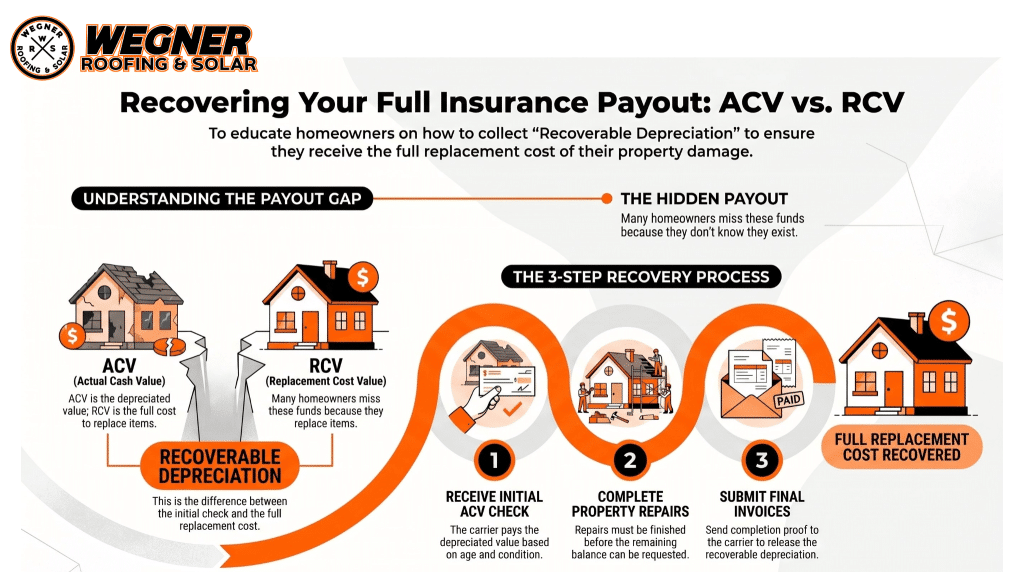
Replacement Cost Value (RCV): Your insurance carrier pays the full cost of replacing damaged roofing materials with new materials of like kind and quality, minus your deductible. This is the preferred coverage type for homeowners in hail-active markets like Billings.
Actual Cash Value (ACV): Replacement Cost Value policies pay the full cost to replace with new materials, while Actual Cash Value policies pay replacement cost minus depreciation. On a 15-year-old asphalt roof in Billings, an ACV policy may return as little as 30–40 percent of the actual replacement cost, leaving the homeowner responsible for the balance.
Review your declarations page now, before peak hail season. Knowing your coverage type, deductible amount, and claim filing deadline is the single most important preparation step before a Billings storm hits your neighborhood.
Step 1 — Spot the Real Damage Before Your Adjuster Does
Ground-Level Signs Any Billings Homeowner Can Check Today
The most valuable hail damage roof inspection you can do as a homeowner requires no ladder. After any hail event that tracks through your Billings zip code, check these targets from ground level:
Gutters and downspout discharge areas. Hailstones knock ceramic granules off shingles, stripping UV protection and exposing raw asphalt. Those granules migrate into gutters and deposit at downspout discharge points on the ground. A heavy accumulation of dark, sand-like granule material after a storm is one of the clearest visible indicators of shingle surface damage and it’s visible from your driveway without climbing anything.
Soft metal surfaces. Inspect gutter aprons, roof vent caps, pipe boot flashings, and any exposed HVAC flashing visible from the ground. Photograph your gutters, downspouts, and siding dents in these softer metals often indicate roof damage that may not be visible from the ground. Hail that dents those surfaces at a measurable depth almost certainly produced corresponding impact bruises on your shingles. Soft metal tells the story your shingles can’t tell from 20 feet below.
AC condenser fins and window screens. Both are soft-metal surfaces that record hailstone impacts clearly. A condenser with circular dents on its upper fin surfaces, photographed with a date stamp, is strong corroborating documentation when you file a claim for your hail damage roof in Billings, MT.
Why "No Leak" Doesn't Mean "No Claim"
Hail impact on standard architectural shingles creates a bruise, a circular area where the underlying fiberglass mat fractures and the granule protection is stripped away. The waterproofing layer below doesn’t fail immediately. Once shingles are bruised, cracked, or granules are knocked loose, the roof can age faster and fail sooner. UV exposure, Montana’s heat cycling, and Billings’ freeze-thaw stress at that weakened point accelerate deterioration, and a leak typically develops 18–36 months after the storm event. If a storm tracked through your zip code in the last 12 to 18 months and you haven’t scheduled a roof inspection, your insurance claim window may be closing faster than you realize.
This delayed-failure pattern is why a documented post-storm inspection matters more than whether your home is currently dry. A professional inspection that captures the date, hail path, and shingle-level damage creates a documented link between your roof’s condition and a specific weather event precisely what an adjuster and your carrier need to process your claim.
Step 2 — Call Wegner Roofing Before You Call Your Insurance Company
What a Professional Inspection Produces
When the Wegner Roofing & Solar Billings team arrives for your free inspection, the deliverable is not a verbal estimate — it is a written, photographic inspection report that documents:
- The inspection date and the verified hail event date for your specific address, confirmed against third-party storm track data
- Shingle-level findings on each roof plane, including granule loss measurements and mat fracture locations
- Soft-metal impact documentation with diameter measurements that corroborate the hail event
- Pre-existing versus storm-related damage, clearly separated for adjuster review
- Estimated replacement or repair scope tied to current Billings material and labor costs
“A certified roof inspection produces the documentation insurers require for claim approval. Carriers and adjusters assigned to Yellowstone County claims process cases faster and more accurately when inspection data prepared by a roofing contractor is present at the time of filing
Step 3 — File Your Hail Damage Roof Insurance Claim: The Full Sequence
The Four-Step Filing Process
Once your Wegner inspection is complete, filing your hail damage roof insurance claim follows this specific sequence:
- Contact your carrier’s claims line. Report the storm event, your address, and the approximate event date. Request a claim number and record it immediately in writing.
- Submit your Wegner inspection report and all supporting photos through your carrier’s online portal or claims email. Request written confirmation of receipt and retain the timestamp.
- Schedule an adjuster appointment and notify Wegner. Coordinate your adjuster’s site visit with Wegner’s insurance team so a restoration specialist can be present during the meeting.
- Review your Statement of Loss before accepting any settlement. Compare the adjuster’s scope line by line against the Wegner inspection report. Do not sign anything until discrepancies are resolved.
RCV vs. ACV: Know Exactly What You're Owed
If you carry RCV coverage, your initial check from the carrier typically reflects only the actual cash value, the depreciated amount rather than the full replacement cost. The difference between those two figures is called recoverable depreciation, and it is released once your repairs are completed and final invoices are submitted to the carrier. Your policy may provide replacement cost once repairs are completed, your initial payment is typically the actual cash value portion, which reflects depreciation based on the age and condition of the damaged items. Many Billings homeowners never collect this money because they don’t know it exists. Wegner’s insurance team walks every claim customer through the recoverable depreciation step before the project closes, ensuring the full entitled payout is collected.
The Adjuster Meeting — What to Expect and Why Presence Matters
Your adjuster’s on-site inspection for a residential roofing in Billings, MT typically runs 45–90 minutes. They will walk the roof, photograph documented damage, and produce their own scope of work document. Adjusters may underestimate damage to minimize payouts, don’t hesitate to ask questions or request a second opinion if the assessment feels incomplete. Having your own roofing expert present can help ensure a fair evaluation. A Wegner restoration specialist on-site during this meeting catches missed damage on north-facing planes, overlooked flashing at pipe penetrations, and skipped interior attic documentation before the adjuster’s report is submitted and the settlement figure is locked.
Step 4 — What to Do When Your Settlement Falls Short
What Adjusters Miss on Billings Storm Damage Cases
Initial hail damage claim settlements in Billings are frequently incomplete, not always from bad faith, but because standard adjuster protocols overlook specific line items that are standard in Montana roof replacements. The most common omissions Wegner’s team identifies:
Montana building code upgrades. Most insurance adjusters are not familiar with or intentionally do not include, the required code upgrade that Montana Roof Building Code requires. Updated drip edge specifications, decking fastening schedules, and ventilation compliance requirements are legitimate, required costs that belong on your claim and are routinely excluded from initial adjuster estimates.
Soft metal replacement beyond the roof surface. Gutters, downspouts, vent caps, and flashing damaged by the same storm event that damaged your shingles belong on the same claim. Many initial estimates exclude them entirely.
Interior entry point documentation. Attic moisture intrusion, saturated insulation, and damaged decking sheathing identified during a thorough inspection but not documented during a brief 45-minute adjuster visit are missed with regularity on Billings claims.
How Wegner Files Supplemental Claims on Your Behalf
When an initial Billings hail damage claim settlement falls short of the documented scope, Wegner’s insurance team files a supplemental claim on the homeowner’s behalf. This process involves submitting updated documentation with itemized, line-by-line justification for each missing component.
While you are navigating the claims process, preventing secondary water damage to your property is critical. To learn what immediate steps to take, read our guide on Emergency Roof Tarping in Montana: How to Protect Your Home Until Help Arrives.
When a contractor’s estimate is higher than what the insurance adjuster plans to pay, contact your adjuster right away. In many cases, the adjuster will speak directly with your contractor to review the differences and make corrections if necessary. As one of the leading roofing companies in Billings, Wegner manages this process from first contact through final payment on every Billings insurance project.
Billings Neighborhoods With the Highest Hail Claim Concentration
Billings Heights and the West End
Billings Heights, the large established residential area north of the Rimrocks, primarily constructed between the 1960s and 1990s carries a high concentration of asphalt shingle roofs at or near functional end of life. Storm events producing even moderate hail over the Heights accelerate those aging timelines substantially. Older West End subdivisions near the 24th Street West corridor share the same profile. Locations regularly impacted by Billings-area severe weather include Billings, Laurel, Lockwood, Billings Heights, Billings West End, Huntley, and Acton. Newer construction along the Shiloh Road corridor trends toward storm damage assessment and Class 4 product installations.
Lockwood and the Shiloh Road Corridor
Lockwood sits immediately east of Billings in Yellowstone County, consistently in the path of storm systems that track northeast through the Yellowstone Valley. Events that clip the Billings city limits frequently impact Lockwood at full intensity. Properties along Broadwater Road and the Lockwood residential developments have generated consistent insurance claim volume after each spring storm season. The Shiloh Road commercial corridor adds commercial flat roofing claims to post-storm volume, TPO membrane seams, modified bitumen edges, and drainage systems all require post-event documentation.
South Side and Rimrock-Area Properties
South Side homes represent a productive mix of retail replacement and insurance-driven projects, with many structures in the 20–30 year age range carrying original roof systems. Rimrock-area properties face a specific added exposure: northerly weather systems accelerating over the cliff formation create localized wind loading that compounds hail impact damage on windward roof planes. Impact-resistant shingle systems and standing seam metal roofing perform measurably better on Rimrock-adjacent properties than standard architectural shingles under these combined stress conditions.
Frequently Asked Questions About Hail Damage Roof Insurance Claims in Billings, MT
How long do I have to file a hail damage roof insurance claim in Montana?
Most Montana homeowner policies allow 1–2 years from the storm date to file a hail damage roof insurance claim but this varies by carrier and some policies require faster reporting. File as soon as you suspect damage.
Does homeowner's insurance cover roof replacement after hail in Billings, MT?
Yes, if you carry RCV coverage and hail is the documented cause, your carrier pays for full roof replacement minus your deductible. Homeowner’s insurance generally covers damage caused by sudden and accidental events such as storms and hail meaning a severe storm causing significant damage should typically be covered, subject to your policy limits and deductibles.
What does a hail damage roof insurance claim pay out in Billings?
Residential roof replacement in Billings ranges from $8,000 to $20,000 depending on square footage, pitch, material selection, and applicable permit costs. Insurance payouts for hail damage claims generally fall between $12,000 and $17,000, which often covers a significant portion of replacement or repairs after deductibles.
Will filing a hail claim raise my insurance premium in Montana?
Hail damage is a weather event, not homeowner negligence. Bad weather is not caused by negligence, and hail damage claims are generally considered “no-fault.” Most Montana policies classify storm damage claims as no-fault, meaning a single hail claim is unlikely to trigger a premium increase. Carriers may review rates if multiple claims are filed within a short window.
Can Wegner attend the adjuster inspection with me?
Yes, and this is a standard part of Wegner’s insurance claim process on every Billings project at no additional cost to you. Having a Wegner restoration specialist present during the adjuster meeting ensures damage on secondary roof planes, flashing, soft metals, attic entry points, and
Your Billings Hail Damage Roof Insurance Claim Starts With One Free Call
If a hail event passed through your Billings zip code in the last 18 months and your roof has not been inspected, there is a real chance you are carrying insurance-covered damage. The window to correctly file your hail damage roof insurance claim is narrowing with every passing week. The Wegner Roofing & Solar Billings team provides free inspections, complete documentation, adjuster advocacy, and supplemental filing at no additional cost to you.
Find us locally at 720 Lohwest Ln, proudly serving Billings Heights, Lockwood, the Shiloh corridor, and all of Yellowstone County. We have earned 2,000+ five-star reviews across five states, hold a #86 national ranking from Roofing Contractor Magazine, and back every project with a 5-year warranty. Furthermore, our Price Beat Guarantee ensures you will never overpay for premium quality in the Billings market.
Spring storms are active right now. Do not let a legitimate coverage window close on hidden damage. Protect your greatest investment and maximize your payout before time runs out. Book your roof inspection online with Wegner Roofing & Solar today!
Get Your Free Estimate
