- Family owned since 2011
Master Your Historic Home Exterior Renovation: 2026 NCOD Guide
2,000+
Five-Star Reviews
5,000+
Projects Completed
15 Years
In Business
24/7
Emergency Response
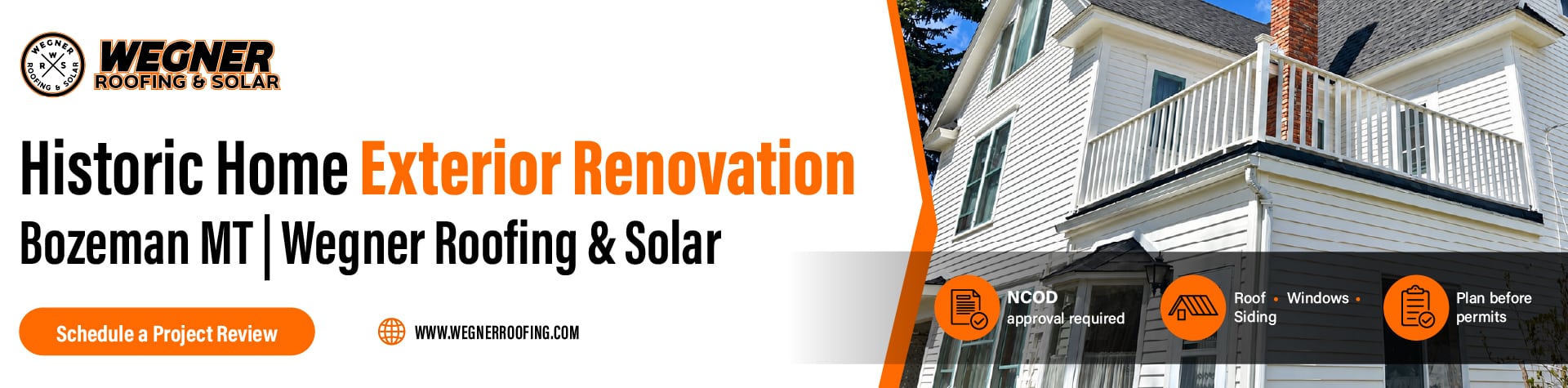
Any historic home exterior renovation in Bozeman MT located inside the Neighborhood Conservation Overlay District requires a Certificate of Appropriateness before you replace a roof, swap a window, or alter siding. A standard building permit alone will not cover you. Skipping that approval step is the single most common reason historic renovation projects in Bozeman stall mid-contract, sometimes after materials have already been ordered and a crew is on the schedule.
This guide walks through exactly what the NCOD requires in 2026, why the city’s long-promised design guideline rewrite is currently on hold, and how to time a roof or window project around Bozeman’s review calendar and short construction season. We’ll point you to the specific pages where we cover materials, pricing, and installation details, since this page stays focused on one thing: getting your project approved before a crew ever shows up.
Not sure if your property falls inside the NCOD boundary, or where your project stands with HPAB? Contact Wegner Roofing & Solar at +14065584468 for a straightforward review of your scope before you file anything with the city.
What the NCOD Actually Requires Before You Touch a Historic Roof, Window, or Wall
The Neighborhood Conservation Overlay District has existed since 1991 and currently covers more than 4,000 properties in and around Bozeman’s historic downtown core. The city’s own project materials describe nine National Register Historic Districts within the NCOD boundary, though some city preservation pages reference ten districts and 46 individually listed National Register properties. That discrepancy exists in the city’s own published records, so don’t assume your property’s status based on a single webpage. Confirm it directly.
The 2006/2015 Guidelines Are Still What Governs Your Project Right Now
The design standards currently in effect were adopted in 2006 and received a minor update in 2015. These are the rules a reviewer will apply to your roof or window application today, in 2026, regardless of what a newer draft might eventually say.
Why the City's 2026 Guideline Rewrite Is Paused and What That Means for Your Timeline
Bozeman started a full rewrite of the NCOD design guidelines earlier in 2026, running community open houses, neighborhood walking tours, and an online survey. That work has stalled. The city terminated its contract with its consultant, the Lakota Group, after conduct issues at a Historic Preservation Advisory Board meeting, and City Commission redirected priority toward finishing a Local Landmark Program and revising demolition regulations first. A new consultant isn’t expected to be engaged until late 2026 at the earliest.
What this means for you: don’t plan your project around rules that don’t exist yet. The 2006/2015 guidelines are what you’ll be reviewed against for the foreseeable future, and any contractor who tells you otherwise hasn’t checked the current project status.
How to Confirm Your Property Sits Inside the NCOD Boundary
Not every older home in Bozeman is inside the overlay. Properties in Cooper Park, the Bon Ton Historic District, Lindley Park, and the blocks surrounding Centennial Park are reliably inside it. Newer-build neighborhoods like Valley West and Four Corners are not, which is why renovation scope and approval requirements differ so sharply between those areas even when the homes are only a few miles apart.
Certificate of Appropriateness vs. Building Permit: Two Approvals, Two Clocks
A building permit confirms your project meets structural and life-safety code. A Certificate of Appropriateness confirms your exterior changes are compatible with the historic character of the district. In the NCOD, you typically need both, and they run on separate clocks.
NCOA, CCOA, and DEM: Which One You Need
Approval Type | Applies To | Typical Review Path | Added to Project Timeline |
NCOA (Neighborhood Certificate of Appropriateness) | Residential roof, window, siding, and exterior alterations | Staff-level administrative review for minor work | Several business days to 2 weeks |
CCOA (Commercial Certificate of Appropriateness) | Commercial storefronts, mixed-use buildings in historic districts | Staff review, escalates to HPAB for major changes | 2 to 4+ weeks |
DEM (Demolition Review) | Full or partial demolition of a contributing structure | Separate submittal, often a dedicated hearing | 30 to 45+ days |
Standard Building Permit | Structural, electrical, and code compliance | Building Division review, independent of COA | 2 to 4 weeks, runs in parallel |
Staff-Level Administrative Review vs. Full HPAB Review
Minor, like-for-like repairs (matching shingle replacement, in-kind window repair) are frequently cleared through administrative staff review without ever reaching a board meeting. Anything that changes a visible material, alters window proportions, or affects a street-facing elevation is more likely to require a hearing in front of the Historic Preservation Advisory Board, which meets on a monthly cycle. That monthly cadence is the detail most homeowners miss: miss one month’s agenda deadline and your project waits another four to five weeks for the next meeting.
What Goes Into Your NCOA Submittal
A complete submittal generally includes current photographs of the affected elevation, a description of the proposed material and how it compares to the existing material, and manufacturer specifications for anything being installed. Reviewers are evaluating compatibility, not aesthetics in the abstract, so vague descriptions (“new energy-efficient windows”) get kicked back far more often than specific ones (“vinyl double-hung, matching existing 2-over-2 muntin pattern, white frame”).
The Repair-First Rule: When You're Required to Fix Instead of Replace
Bozeman’s historic preservation framework operates on a repair-first philosophy borrowed from the Secretary of the Interior’s Standards: if an original material can reasonably be repaired, replacement is discouraged, not just discouraged in spirit but often flagged during review.
Cedar Shake Roofing in Bon Ton and Cooper Park
A meaningful share of the Bon Ton Historic District and the older sections around Cooper Park still carry original cedar shake roofing, some dating to the early 1900s. Cedar shake has a realistic 20 to 30 year lifespan in Montana’s climate, and freeze-thaw cycling (Gallatin County logs roughly 90-plus freeze-thaw cycles annually per NOAA data) accelerates splitting well before that window closes. If less than 25 percent of the roof surface is compromised, a reviewer may expect spot repair with matched material rather than full replacement. Once damage exceeds that threshold, or the decking underneath is compromised, full replacement becomes the defensible path, and that’s where material selection, snow load rating, and underlayment choice start to matter. Our full breakdown of roofing contractors in Bozeman, MT covers snow load requirements and material options for exactly this scenario.
Original Wood Windows Downtown and in Lindley Park
Original single-pane wood sash windows are common on pre-1940 homes downtown and in Lindley Park. These frequently lack any thermal break, and a typical assembly in this condition carries a U-factor in the 0.70 to 0.85 range, far above Montana’s 0.30 code maximum for new installations. Despite that performance gap, a reviewer may still require sash repair, re-glazing, or weatherstripping upgrades over full removal if the frame itself is structurally sound, since the window’s visual proportions and divided-light pattern are considered character-defining features of the district. Full replacement is typically approved only once rot, warping, or missing glazing make repair impractical. Our page on window contractors serving Bozeman and Belgrade goes deeper into how we evaluate frame condition before recommending either path.
A quick example: A homeowner near Bon Ton with a 1934 bungalow assumed a full window replacement would sail through review since the originals were drafty and fogged. The HPAB staff review instead approved sash repair and weatherstripping for the street-facing elevation, reserving full replacement approval for the rear and side windows not visible from the public right-of-way. The project still moved forward, just in two phases instead of one, and the owner avoided a costlier full-elevation replacement that likely would have triggered a longer board review.
What Changes When Demolition Enters the Conversation
The Non-Conforming Structure Threshold Reviewers Check First
If a renovation scope includes removing more than a defined percentage of an exterior wall, roofline, or structural element, it can trip demolition review (Form DEM) rather than standard COA review. This is a separate submittal with its own hearing process, and it runs independently of your building permit timeline.
Why the Local Landmark Project Could Reshape Future Approvals
City Commission has signaled interest in using a forthcoming Local Landmark Program to apply more tailored design standards to specific designated districts, rather than one uniform rule across the entire NCOD. That program isn’t finalized, but it’s the project currently receiving priority attention over the general guideline rewrite, which is worth watching if your property sits in one of the nine (or ten, depending on the source) historic districts.
Planning Your Renovation Around Bozeman's Review Calendar and Winter Weather
Fall: Documentation and Pre-Application Prep
Right now, in October and November, is the right window to photograph your current roof and windows, pull your property’s historic designation status, and start drafting your NCOA narrative. Doing this before snow complicates roof access gives you a cleaner photo record for your submittal.
Winter: Board Scheduling, Fee Updates, and Material Lead Times
HPAB’s monthly meeting cadence doesn’t pause for winter, so this is when most approvals for spring work actually get granted. It’s also when you should be ordering materials. Custom window sizes and wood-clad units commonly carry a 1 to 4 week manufacturing lead time, longer for anything matching an unusual historic profile.
Spring: Your Approved Installation Window
Once your COA and building permit are both in hand, spring remains the most practical installation season for exterior work in Bozeman, before the limited window for safe roof access on steep historic pitches closes again next fall.

Coordinating Roofing, Window, and Design-Review Work Without Losing a Season
Why One Documented Scope Simplifies Your COA Submittal
Submitting a single, coordinated scope (roof and windows together, with matched material documentation) tends to move through staff review faster than two separate piecemeal applications filed months apart, since the reviewer is evaluating one coherent elevation change instead of guessing what’s coming next. If you’re budgeting both at once, our Bozeman Window Replacement Guide breaks down U-factor requirements and 2026 pricing by frame material, which is useful context to have ready before your HPAB submittal.
Questions to Ask Any Contractor Before They Touch a Historic Elevation
Ask whether they’ve pulled an NCOA before, whether they document existing material condition photographically before starting demolition, and whether they understand the difference between a repair-eligible scope and one requiring full board review. A contractor who can’t answer these clearly is a liability on a historic property, not just an inconvenience. The team at Wegner Roofing & Solar has coordinated exterior scopes across both roofing and window trades for Gallatin Valley properties, including several inside the NCOD boundary, and our window installation services are built specifically around matching historic proportions rather than defaulting to standard new-construction sizing.
If you’d like to see current reviews and confirm our service area coverage before reaching out, our Google Business Profile is kept current with Bozeman and Belgrade project activity.
Frequently Asked Questions
What approvals may apply to roof and window work in the NCOD?
Most exterior changes require a Neighborhood Certificate of Appropriateness in addition to a standard building permit. Minor repairs often clear through staff-level administrative review, while visible material changes or elevation alterations may require a full Historic Preservation Advisory Board hearing.
How does planning approval differ from a building permit?
A Certificate of Appropriateness evaluates whether your exterior change fits the historic district’s character. A building permit evaluates structural and code compliance. They run on separate review tracks and timelines, and most NCOD renovations need both before work can legally begin.
When can historic windows be repaired rather than replaced?
Reviewers generally expect repair over replacement when the original frame is structurally sound, even if the glazing or weatherstripping has failed. Full replacement is typically approved once rot, warping, or missing glass make repair impractical, particularly on elevations not visible from the street.
What should owners prepare in fall and winter for spring exterior work?
Fall is the time to photograph existing conditions and draft your NCOA narrative. Winter is when HPAB approvals for spring projects typically get granted and when custom materials, which can carry 1 to 4 week lead times, should be ordered.
Does the city's 2026 NCOD guideline rewrite change what I need to do now?
No. That rewrite is currently paused while the city prioritizes its Local Landmark Program and demolition code revisions. The 2006 guidelines, with their 2015 minor update, remain the operative standard any NCOA application will be reviewed against through 2026.

About the Author: Shaun Sideris
Shaun Sideris is the Owner and Chief Operating Officer (COO) of Wegner Roofing & Solar, a family-owned exterior contracting company founded in 2011. The company serves homeowners and businesses across Montana, North Dakota, South Dakota, Iowa, and Tennessee. Its services include roof repair, roof replacement, metal and shingle roofing, storm damage repairs, solar installation, siding, and windows. Shaun is part of the leadership team at a company whose stated values center on integrity, honesty, and trust. Wegner emphasizes clear project communication, transparent pricing, and informed customer decisions, with a focus on quality workmanship and lasting relationships with the communities it serves.
Get Your Free Estimate
