What Changed with Solar Tax Credits in 2026?
The One Big Beautiful Bill Act, signed in July 2025, accelerated the sunset of the residential solar credit. Starting January 1, 2026:
- Homeowners cannot file IRS Form 5695 for a new solar installation.
- The direct solar panel tax deduction for residential purchases no longer exists.
- The commercial energy credit, Section 48E, remains active through 2027.
This shift doesn’t eliminate solar savings; it changes how you structure the deal. Understanding this distinction is the difference between a smart solar investment and a frustrating surprise at tax time.
The 2026 Solar Playbook: Leases, PPAs, and State Incentives
Third-Party Ownership: How Homeowners Still Benefit
Solar leases and Power Purchase Agreements (PPAs) are now the primary vehicle for accessing residential solar incentives in 2026.
Here’s how it works:
- The solar company owns the system installed on your roof.
- They claim the Section 48E commercial credit and factor those savings into your contract rate.
- You pay a fixed, lower monthly rate for the power your system produces, often well below your current utility bill.
- No large upfront investment is required in many cases.
This model keeps solar tax credits 2026 working for homeowners just indirectly while protecting you from rising grid costs, regardless of future federal policy shifts.
Before installing solar panels, your roof needs to be in peak condition — and Belgrade homeowners in Gallatin County are in an ideal position. Our Belgrade roofing and solar team evaluates your existing roof structure, identifies any repairs needed before panel mounting, and handles the full installation from a single local contractor. This eliminates the coordination headaches that come with hiring separate roofing and solar companies.
Not sure which solar plan works best for your home? Wegner Roofing & Solar walks Montana homeowners through every available option, leases, PPAs, and purchase plans, so you get the structure that delivers maximum savings.
Get Your FREE Solar Estimate Today! Zero pressure. Real numbers. Real savings.
Rising Utility Rates: The Real Urgency
NorthWestern Energy rates across Billings and Bozeman have continued climbing in 2026.
Locking in a fixed solar rate now, whether through a lease, PPA, or direct purchase, shields your household from unpredictable future hikes.
That protection alone is worth thousands over a 20–25 year system lifespan, even without a direct residential tax credit.
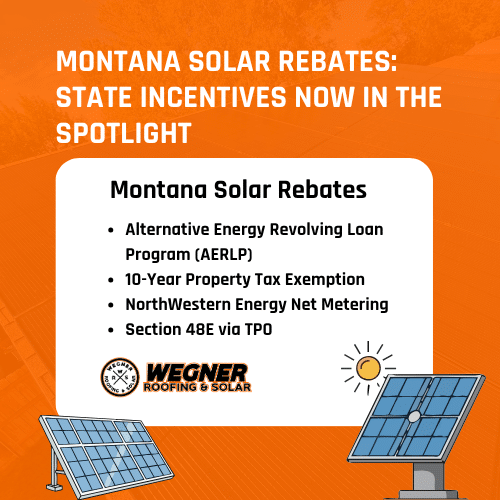
Montana Solar Rebates: State Incentives Now in the Spotlight
With the residential federal credit gone, Montana’s state programs have become the most powerful financial tools available for homeowners near the Rimrocks in Billings or Bridger Bowl in Bozeman.
These Montana solar rebates are now the headline:
- Alternative Energy Revolving Loan Program (AERLP): State-administered loans up to $40,000 at a fixed 3.5% rate for up to 10 years, making owned systems accessible without the old residential credit cushion. Note: this is a separate state program, distinct from any in-house financing your installer may offer.
- 10-Year Property Tax Exemption: Solar panels add zero additional taxable property value for a full decade, a hard dollar benefit that compounds annually.
- NorthWestern Energy Net Metering: Billings and Bozeman homeowners earn bill credits by sending surplus power back to the grid.
- Section 48E via TPO: Solar companies still pass commercial credit savings through lease and PPA agreements, delivering competitive monthly rates.
Montana averages roughly 180–205 sunny days per year, and cold, clear winter days allow solar panels to operate efficiently even in snowy conditions.
That reliable output, combined with these Montana solar rebates, still creates a strong long-term return. Explore Montana solar options in detail!
Montana Homeowners: Let’s Find Your Best 2026 Solar Option
Wegner Roofing & Solar has served communities since 2011 with 1,000+ five-star reviews.
Book Your Free Appointment | Find us in Billings, MT
Key Takeaways
- The residential federal solar tax credit 2026 (Section 25D) expired December 31, 2025. Personal tax claims are no longer available for homeowners.
- Section 48E (commercial credit) remains active through 2027, and solar companies pass savings to homeowners through leases and PPAs.
- Montana solar rebates, AERLP loans at a fixed 3.5%, and a 10-year property tax exemption are now the strongest available financial tools for Montana homeowners.
- Rising NorthWestern Energy rates make long-term solar ROI compelling even without the old residential credit.
- Montana averages 180–205 sunny days annually, supporting efficient solar performance across all seasons.
The Rules Changed | Your Opportunity Didn’t
Yes, the solar tax credits 2026 landscape looks different from what it did a year ago.
But Montana homeowners bracing for another Gallatin Valley winter are still running the same math: electricity rates keep climbing, and solar locks in your cost.
Montana’s AERLP loan at 3.5%, the 10-year property tax break, and smart lease or PPA agreements mean the path to real savings is still wide open in 2026.
The homeowners who adapt to the new structure now will be the ones looking back, grateful they didn’t wait.
Wegner Roofing & Solar offers flexible in-house financing options, including $0 down, completely separate from state programs like Montana’s AERLP loan.
Our team explains every available option in today’s changed incentive landscape clearly and honestly, from system design through installation.
Request Your Free Solar Estimate!
FAQs about Solar Tax Credit
What is the federal solar tax credit for 2026?
The residential federal solar tax credit (Section 25D) expired on December 31, 2025, meaning homeowners who purchase or finance a solar system in 2026 cannot claim a personal federal tax credit.
However, the commercial solar credit (Section 48E) remains active through 2027. Solar companies using lease or PPA models still access this credit and pass those savings to homeowners through reduced monthly energy rates.
How much can solar panels save me?
Even without the residential federal credit, most Montana homeowners save $800–$1,500 annually through reduced utility bills, fixed-rate solar agreements, and available state incentives.
Over a 25-year system lifespan, total energy savings can realistically reach $20,000–$37,500, before accounting for Montana’s 10-year property tax exemption or the long-term protection against rising utility rates.
Do solar panels still work during snowy Montana winters?
Yes! It is a common misconception that solar requires hot weather. In fact, solar panels actually operate more efficiently in cold temperatures. While Billings and Bozeman experience heavy snowfall, Montana still averages 180–205 sunny days per year.
On cold, clear winter days, your panels will produce excellent power. Furthermore, because solar panels are installed at an angle and generate their own slight heat, snow typically slides right off, allowing your system to quickly resume generating electricity.