- Family owned since 2011
How to Spot Wind Damage Roof Risks During Rapid Freeze-Thaw Swing
2,000+
Five-Star Reviews
5,000+
Projects Completed
15 Years
In Business
24/7
Emergency Response
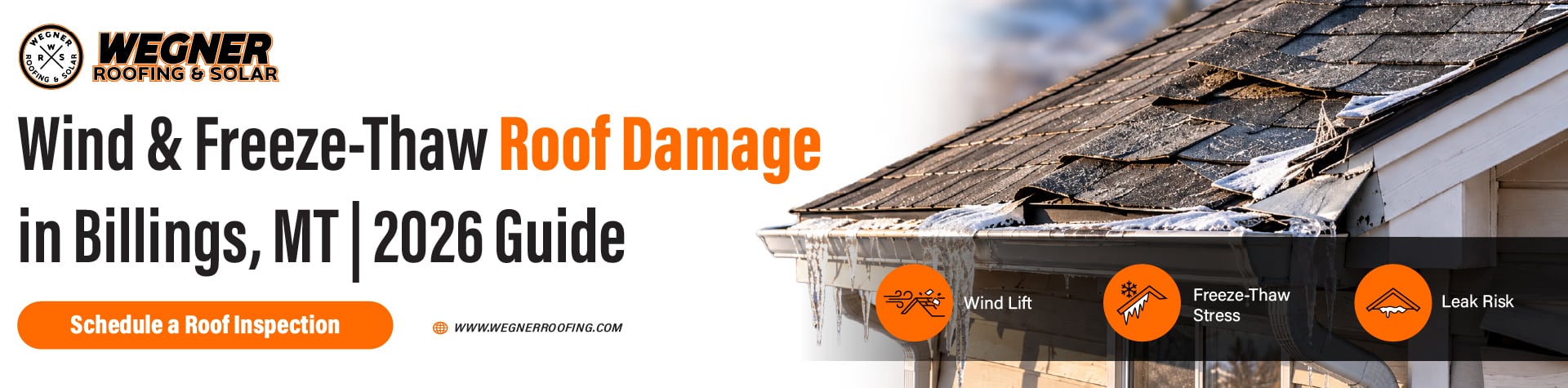
Wind damage roof problems in Billings often trace back to a single afternoon, not a whole season of cold. On December 17 last winter, the National Weather Service recorded a 79 mph gust in the Billings area, with sustained winds hitting 61 mph out of the northwest that same day. That one afternoon put more cumulative stress on roofs and siding across the Heights and West End than three straight months of ordinary winter cold ever could.
Here’s the part of Montana roofing that rarely gets explained clearly: it isn’t the cold itself that tears a roof apart. It’s the swing. A 40-degree jump in a few hours, followed by a hard overnight refreeze, moves roofing and siding materials in ways they were never built to move repeatedly. Below is exactly how that plays out on a Billings roof and sidewall, what to watch for before the next front rolls through, and when it’s time to call in a professional eye before small damage turns into a leak.
Notice shingle lift, a rattling siding panel, or a stain forming after the last windstorm? Schedule a wind-damage inspection with Wegner Roofing & Solar before the next chinook-driven front hits Billings.
Why Billings' Wind-and-Thaw Pattern Isn't a Normal Winter
What a "Chinook-Influenced" Swing Actually Looks Like in Billings vs. the Rocky Mountain Front
True chinook winds, the kind that can push temperatures up 30 to 40 degrees in under an hour, originate along the Rocky Mountain Front near Great Falls and Choteau, roughly 200 miles northwest of Billings. By the time that warm air mass moves east across the Yellowstone Valley, it arrives as a chinook-influenced wind event rather than a textbook chinook. The practical result for a homeowner near MetraPark or out toward Lockwood is the same regardless of the technical label: a fast warm-up paired with strong, gusty wind, followed by an equally fast refreeze once the front passes.
The Numbers Behind It: Billings' Recorded Gusts and Temperature Swings
According to National Oceanic and Atmospheric Administration (NOAA) climate records for Billings, three figures matter far more than any generic “harsh winter” warning:
- Average wind speed in Billings runs 10.3 mph year-round, which is already elevated compared to most Midwest and Southern markets. Roofing materials here are under constant low-grade wind load even on calm-feeling days.
- Peak recorded gusts reach into the 70 to 80 mph range during a single winter season, a threshold that exceeds the wind rating of many standard shingle lines.
- Normal first freeze in Billings falls around October 6, with hard freeze typically by September 26. That means the freeze-thaw clock starts well before most homeowners book a winter inspection.
Asphalt shingles in Billings last 18 to 22 years under proper conditions, as covered in our blog about roof ventilation Billings MT. Repeated high-wind, freeze-thaw cycles are one of the two or three variables that most reliably cut that lifespan short.
How Wind Damage Shows Up on a Billings Roof
Shingle Lift, Crease, and Blow-Off Thresholds
Every asphalt shingle carries a wind-resistance rating tested under one of two ASTM standards, and the difference matters a lot more in Billings than in a calmer climate.
Wind Rating Standard | Tested Wind Speed Threshold | What It Means for a Billings Roof |
ASTM D3161, Class F | Up to 110 mph | Entry-level wind rating; a single 70+ mph gust event, which Billings records most winters, pushes close to the edge of this rating’s safety margin |
ASTM D7158, Class H | Up to 150 mph | Higher-tier rating most manufacturers recommend for open, wind-exposed sites like the Heights or properties near Lake Elmo State Park |
IKO Nordic limited high-wind warranty | Up to 130 mph | A mid-tier option that splits the difference, commonly specified for standard suburban lots in the West End and South Side |
A shingle does not need to blow off entirely to count as wind damage. The more common failure is a creased or lifted tab that breaks the asphalt mat’s seal, which then lets wind-driven moisture work underneath it during the next thaw. That is a repair-now issue, not a wait-and-see one, and it is exactly what our team for roof repair in Billings checks for first during a wind-damage inspection.
Flashing and Fastener Fatigue After Repeated Gust Cycles
Metal flashing around chimneys, skylights, and roof-to-wall transitions expands and contracts with every temperature swing. One cycle does nothing. Fifteen or twenty cycles over a single December, which is a realistic count during an active chinook-influenced winter, works fasteners loose at the exact seams where leaks start. Homes near Downtown Billings with older flashing details are the most common calls we get for this specific failure mode.
How the Same Wind Events Damage Billings Siding
Vinyl Siding Panel Lift and Cold-Weather Oil-Canning
Vinyl siding becomes measurably more brittle as temperatures drop below freezing, which is precisely when Billings’ wind gusts tend to peak. A sustained 60+ mph gust can lift an improperly fastened panel at the bottom lock, and once that happens the panel above it loses its interlock and becomes vulnerable to the next gust. Our Billings siding contractors sees this most often on homes in the Josephine Crossing area and along the Shiloh Road corridor, where open lots offer less wind-break from mature trees.
Fiber Cement and Insulated Siding: Different Failure Signatures
Fiber cement siding does not lift the way vinyl does, but it is heavier and more rigid, which means wind-driven debris impact (branches, hail carried on gusts) tends to chip or crack panels rather than dislodge them. Insulated siding, meanwhile, traps a thin air layer behind the panel face. If that seal is compromised at a seam, repeated freeze-thaw cycling can force moisture into the foam backing, which is a slower, quieter failure that often isn’t visible until a panel is removed.
The Freeze-Thaw Multiplier: Why a Rapid Warm-Up Is Worse Than Steady Cold
The Melt-Refreeze Cycle at the Eave Line
A chinook-influenced warm-up melts the top layer of snow on a roof deck. That meltwater runs downhill toward the cold eave overhang, which never warms as much as the rest of the roof because it sits beyond the heated living space below. When the front passes and temperatures crash again overnight, that water refreezes right at the edge, forming the start of an ice dam. This is a mechanical process, not bad luck, and it repeats every time Billings sees one of these swings. Our guide about winter roof preparation in Billings MT covers the broader seasonal checklist; this is the specific wind-driven version of that same problem.
Mini Case Study: A Heights Home After a Three-Day Thaw Swing
A homeowner near Alkali Creek in the Heights called us in February after noticing a water stain spreading across a bedroom ceiling. Three days earlier, Billings had jumped from 18°F to 54°F in an afternoon, with gusts recorded near 55 mph, before dropping back below freezing that same night. Our inspection found no missing shingles and no obvious wind damage from the street. The actual cause was a hairline crease in three tabs near the north-facing valley, invisible from the ground, that had been slowly working loose over two prior wind events. The thaw simply gave the moisture somewhere to go. The fix was a roof repair, not a replacement, because the damage was caught before the sheathing underneath was compromised.
Warning Signs That Need a Professional Inspection This Season
Any one of these on its own is worth a call. Two or more together means don’t wait for the next storm cycle:
- A single shingle tab visibly lifted or creased, even if the rest of the roof looks fine from the ground.
- A new dark streak or stain on an interior ceiling that appeared within a day or two of a windy thaw event.
- A siding panel that rattles or flexes noticeably in wind that didn’t move that way last year.
- Granules collecting in gutters or downspouts after a specific windstorm, rather than gradually over the whole season.
- Ice forming unevenly along one section of the eave line while the rest of the roof edge stays clear.

Each of these traces back to the same root mechanism: wind-driven stress combined with a freeze-thaw cycle looking for a weak point to exploit.
Where This Fits Into Your Fall-to-Winter Roof and Siding Plan
Wind and freeze-thaw damage rarely needs an emergency call the moment it happens. It needs a timely one. If you’ve already noticed interior leaking, active shingle loss, or siding that has physically detached, that moves into true emergency territory, and our 24/7 emergency roofing response team is built for exactly that scenario across Yellowstone County, including Lockwood and Laurel.
For everything short of that, the smarter move is a proactive inspection before the next big wind-and-thaw cycle hits, not after. Wegner Roofing & Solar has been diagnosing this exact failure pattern across Billings since 2016, and as a family-owned local roofing contractor ranked #61 nationally by Roofing Contractor Magazine’s 2026 Top 100, we treat a wind-damage assessment with the same precision as a full roof replacement estimate. You can also find our current reviews and service details on our Google Business Profile, where our team is available around the clock.
Frequently Asked Questions
How do chinook winds affect Billings roofs and siding?
Chinook-influenced warm-wind events push temperatures up 30-40°F in hours, loosening shingle seals and flexing siding panels, then a fast refreeze locks that movement in place. Billings has recorded gusts up to 79 mph during these swings, well past the rating of many standard shingles.
How can rapid thaw and refreeze expose roof problems?
A quick thaw melts snow on the roof deck, sending meltwater toward the cold eave edge where it refreezes into ice. This cycle finds and widens existing weak points, like a creased shingle tab, that were otherwise invisible from the ground.
Which warning signs need a professional inspection?
A lifted or creased shingle, a new interior ceiling stain, a rattling siding panel, sudden granule buildup in gutters, or uneven ice at the eave line all warrant a prompt inspection. Two or more occurring together signal an active, worsening problem.
How do roof and siding repairs fit into winter preparation?
Wind and freeze-thaw repairs should happen before the next major storm front, not during one. Pairing a targeted repair with your broader fall inspection checklist prevents a small, fixable issue from becoming a mid-winter emergency call.
Get Your Free Estimate
