Commercial solar panel installation is a major building project, not just an equipment purchase. Before asking for a quote, property owners should understand the roof’s
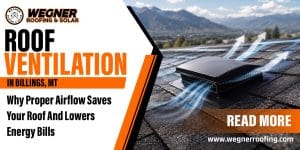
Roof Ventilation in Billings, MT: Why Proper Airflow Saves Your Roof and Lowers Energy Bills
Billings receives over 50 inches of snow each year, and temperatures routinely swing 40°F between a warm afternoon and a hard overnight freeze.
This daily pattern is familiar to homeowners from the Heights to the Rimrocks, and is one of the most persistent threats to your roof. It doesn’t start at the shingles. It starts in your attic.
Roof ventilation in Billings, MT, is the most overlooked component of any roofing system.
In 2026, correcting or upgrading ventilation on a standard Billings home costs $500 to $1500, a fraction of the $8,000–$20,000 roof replacement that unaddressed airflow problems tend to accelerate.
What Poor Attic Airflow Costs Billings Homeowners
Most homeowners in the Heights or West End never think about their attic until something goes visibly wrong.
An unventilated attic in a Billings summer holds temperatures above 140°F, and that heat attacks your shingles from below, drying out the asphalt mat and stripping granules ahead of schedule. As ENERGY STAR’s guidance on attic ventilation explains, a properly vented attic moves that superheated air out in summer, protecting shingles while insulation does its job of resisting heat transfer into the home below.
Asphalt shingles in Billings last 18–22 years under proper conditions; chronic attic heat can shorten that by 5 or more years.
In winter, the problem reverses direction. Warm interior air rises into the cold attic, condenses on the sheathing, and causes wood rot and mold.
It also warms the snow on your roof deck, directs meltwater toward the cold eave overhang, and creates ice dams, a recurring issue in older Billings Heights and West End homes that proper roof ventilation directly prevents.
The Four Components of a Balanced Roof Ventilation System
Roof ventilation in Billings, MT, works as a balanced intake-and-exhaust system. Each of the four components below has a specific role, and the system underperforms when any one of them is wrong.
Soffit Vents: Where Cool Air Enters
Soffit vents run along the underside of your roof overhang and draw fresh air into the attic at the lowest point. Many Billings homes built before 1990 have undersized or partially blocked soffit vents, a condition that undermines the effectiveness of every other part of the system.
Ridge Vents: Where Hot Air Exits
Ridge vents run along the peak of your roof and allow rising hot air to escape through passive convection. A balanced soffit-to-ridge system keeps attic temperature within 10–15°F of outside air year-round, with no power, no moving parts, and no maintenance required.
Gable-End Vents
Gable vents are installed in the triangular end-wall section of your home and cannot supplement passive airflow where ridge vents are present, as combining them short-circuits the system. Older Downtown Billings and South Side homes often rely on gable vents as their primary exhaust system.

Power Attic Ventilators
Power attic ventilators activate when attic heat or humidity exceeds a set level. They’re most useful in Billings homes with complex rooflines that restrict passive airflow and lack passive ridge vents, and many models connect directly to a thermostat for automatic operation.
Not sure what’s happening above your ceiling?
Call Wegner Roofing & Solar in Billings today for a free roof ventilation inspection.
Why Roof Ventilation Problems in Billings Look Like Something Else
This is where most homeowners get misled. Attic ventilation roof issues rarely announce themselves directly. They show up instead as:
- Ice dams form along the eave line each January.
- Shingles curling or blistering ahead of their rated lifespan.
- Heating bills are increasing year over year with no clear explanation.
- Frost or visible moisture accumulating inside the attic space in winter.
Each of these traces back to an imbalanced intake-to-exhaust ratio in the roof ventilation system. Adding insulation or swapping out shingles without correcting airflow first produces short-term fixes with long-term consequences.
Our residential roofing inspections in Billings include a full ventilation evaluation at no extra charge because catching the airflow problem before installation is far cheaper than correcting it after.
Ready to replace your roof the right way?
Our Billings roofing team designs proper ventilation into every project from day one, with no surprises, no add-ons. Request your free estimate today.
Pairing Ventilation With Insulation to Stop Ice Dams Permanently
Roof ventilation in Billings, MT, addresses only half of the ice dam equation when attic insulation is also inadequate.
Heat escaping through the roof deck warms the snowpack above it, drives runoff toward the cold eave overhang, and causes it to refreeze.
Billings falls in Climate Zone 6, where attic insulation should reach R-49 to R-60 to properly separate your living space heat from the roof assembly above it.
Correcting both at once, ventilation balance plus insulation depth, ends ice dams at the source rather than managing them with heat cables every winter.
Our roof ventilation systems page details the full range of vent configurations and insulation pairings we install for Billings homes and commercial properties across Yellowstone County.
Key Takeaways
- Billings’ freeze-thaw cycles and 50+ annual inches of snow make roof ventilation in Billings, MT, a necessity, not an upgrade.
- Attic temperatures above 140°F in summer reduce asphalt shingle service life by 5+ years.
- A complete system includes soffit vents paired with either ridge vents, gable-end vents, or power attic ventilators where roofline geometry requires them.
- Ventilation system upgrades typically run $500–$1,500; new ventilation installed during a roof replacement is included in the project estimate.
- Ice dams are a ventilation and insulation failure, and shingle replacement alone does not stop them.
- Wegner Roofing & Solar includes a ventilation evaluation with every Billings roof inspection.
Don't Let Montana's Climate Win | Correct Your Airflow Before It Costs You a Roof
Roof ventilation in Billings, MT, is the hidden foundation your entire roofing system depends on. An unbalanced attic quietly shortens shingle life, drives up energy bills, and makes ice dams a guaranteed annual problem, while the roof looks completely fine from the street.
Wegner Roofing & Solar has been correcting ventilation failures across Billings, Lockwood, Laurel, and Yellowstone County since 2016. Ranked #86 in the nation by Roofing Contractor Magazine (2025), our team treats a ventilation correction with the same precision as a full roof replacement.
We’ll tell you what the actual problem is before we ever recommend a fix. Protect your roof before Montana’s next freeze-thaw cycle hits.
Schedule your free ventilation assessment with Wegner Roofing & Solar today. Find us on Google to reach our 24/7 emergency response team throughout Yellowstone County.

FAQs About Roof Ventilation in Billings, MT
What causes roof flaWhy is roof ventilation important in Montana? shing to fail?
In Montana, extreme weather and heavy snowfall make proper roof ventilation essential. It prevents severe structural damage like ice dams, wood rot, and mold. Crucially, without a documented intake and exhaust balance, most major manufacturers will void your shingle warranty.
How much does roof ventilation cost?
Upgrading roof ventilation on a Billings home costs $500 to $1,500. During a full roof replacement, Wegner Roofing includes it in your estimate. A compliant system paired with Class 4 shingles can qualify you for insurance discounts by preventing warranty-voiding heat damage.
How do I know if my attic has enough ventilation?
Signs of poor attic ventilation in Billings homes include winter ice dams, attic condensation, prematurely curling shingles, and rising energy bills. The building code requires a 1:150 ventilation ratio. Wegner Roofing provides free attic ventilation assessments throughout Yellowstone County to verify compliance.
Table of Contents
Categories
Latest Posts
September 30, 2026
Energy-Efficient Window Costs in Bozeman, MT Bozeman winters do not play fair. When temperatures drop into the negative teens and Gallatin Valley winds push through
September 28, 2026
Signs Your Bozeman, MT Windows Need Replacing Bozeman winters put real stress on a home. Temperatures can swing from 20 degrees during the day to
September 25, 2026
Preventing Ice Dams on a Belgrade, MT Roof Belgrade homes see 47 to 55 inches of snow most winters, sitting at roughly 4,455 feet of
September 22, 2026
Attic Condensation or Roof Leak? Belgrade, MT Guide Winter in Belgrade, MT, swings from clear, cold mornings to fast-moving Gallatin Valley wind fronts. This wild