- Family owned since 2011
How Many Solar Panels Do You Need for a Billings, MT Home?
2,000+
Five-Star Reviews
5,000+
Projects Completed
15 Years
In Business
24/7
Emergency Response
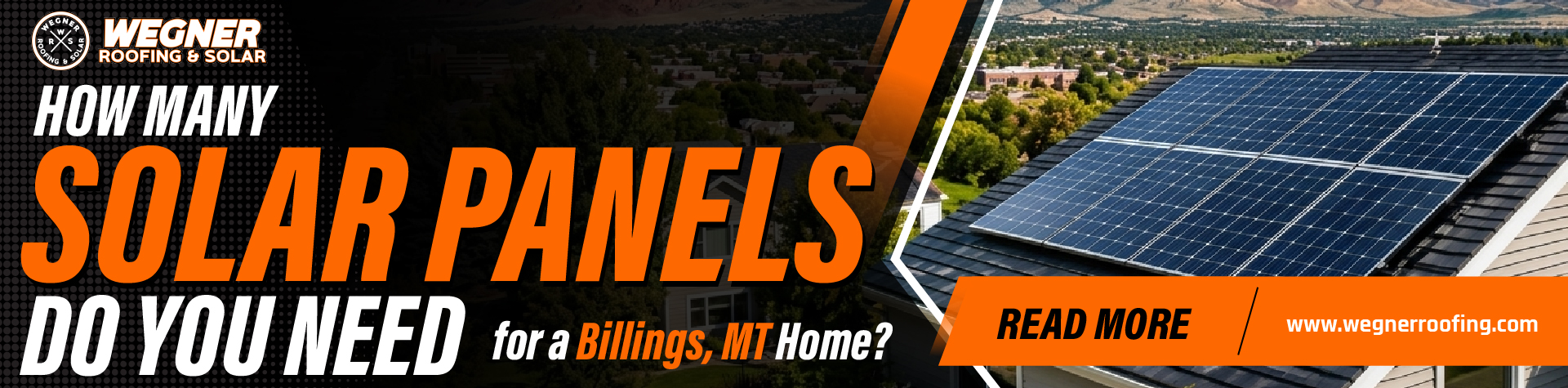
The Billings Solar Formula: Calculating Your Perfect Panel Count
Are you tired of watching your NorthWestern Energy bills spike during a harsh Montana winter or scorching summer? As a Billings homeowner trying to lower costs, you are likely asking yourself: how many solar panels do I need?
The immediate answer for most Billings homes is typically between 11 to 26 panels. This creates a system ranging from 4.9 kW to 11.4 kW, depending entirely on your household electricity usage. However, finding the exact number requires more than a simple guess. It demands a formula that factors in our high plains weather, local sun hours, and your specific roof orientation.
Navigating these variables alone can be costly if you undersize or oversize your system. Stop guessing and let local experts handle the math. Partner with our top rated team and get your solar panels installed by the solar contractors of Wegner Roofing & Solar to ensure an accurate array designed perfectly for your property.
The Quick Answer: Panel Count by Home Type in Billings, MT
Every solar quote starts with the same three inputs: how much electricity you use, how much sun your roof gets, and how efficient the panels are. Here’s how that shakes out for typical Billings households using 440-watt Tier 1 monocrystalline panels, Billings’ average of 4.9 peak sun hours per day, and a standard 83% system derate, the real-world loss from inverter conversion, wiring resistance, and panel soiling.
Home Profile | Avg. Monthly Usage | System Size | Panel Count | Installed Cost (Before 30% ITC) | Cost After Federal Tax Credit |
Small / efficient home (1–2 occupants) | 600 kWh | 4.9 kW | 11 panels | $14,000 – $15,500 | ~$9,950 |
Average Billings home (3–4 occupants) | 950 kWh | 7.9 kW | 18 panels | $22,500 – $24,500 | ~$16,000 |
Larger home (electric heat, AC, EV charging) | 1,400 kWh | 11.4 kW | 26 panels | $32,000 – $35,000 | ~$23,100 |
Small commercial / light industrial | 2,500+ kWh | 19 kW+ | 43+ panels | Custom quote | Custom quote |
Disclaimer: The pricing and tax savings shown above are baseline estimates, as your final out-of-pocket costs will vary depending on your specific equipment choices and installation complexity. Since federal and local incentive programs are subject to legislative changes, we strongly recommend consulting a certified tax professional to verify your personal eligibility before moving forward.
These figures assume a south or west facing roof section with minimal shading, the same baseline our Billings solar contractors at Wegner Roofing & Solar uses before adjusting for your specific property’s pitch and orientation.
The Formula Local Installers Actually Use
You don’t need an engineering degree to sanity-check a solar quote. Here’s the exact math, broken into four steps.
Step 1: Find your daily energy needs.
Pull your last 12 months of NorthWestern Energy bills and average your monthly kWh usage. Divide by 30 to get your daily kWh needed. A home using 950 kWh per month needs 31.7 kWh per day. Twelve months matters here, not three, because Billings usage swings hard between a mild April and a January cold snap.
Step 2: Apply Billings' peak sun hours.
Billings averages 4.9 peak sun hours per day annually, a measure of how many hours of “full strength” sunlight your panels receive, not total daylight hours. Divide your daily kWh needed by this number to get the raw DC kilowatt output required: 31.7 ÷ 4.9 = 6.47 kW.
Step 3: Adjust for system derate.
No solar system converts sunlight at 100% efficiency. Inverter conversion, wiring resistance, dust accumulation, and panel temperature typically account for a 17% loss, meaning your system needs to be oversized by that margin to actually deliver the output you calculated. Divide by 0.83: 6.47 ÷ 0.83 = 7.79 kW, your actual system size target.
Step 4: Convert to panel count.
Divide your system size by your panel’s wattage. At 440 watts per panel: 7,790 ÷ 440 = 17.7, rounded up to 18 panels.
That’s the same formula behind the table above, and it’s the reason two Billings homes with identical square footage can need completely different system sizes if one has a heat pump and an EV charger and the other doesn’t.
Real Example: Sizing a System in the Billings Heights
The Petersons, a family in Billings Heights, came to us after installing a heat pump that pushed their usage to 1,100 kWh a month. Their roof faces south-southwest at a 30-degree pitch with no tree shading, close to ideal conditions for this market.
Running the formula: 1,100 kWh ÷ 30 days = 36.7 kWh per day. Divided by 4.9 sun hours = 7.49 kW raw output. Divided by the 0.83 derate factor = 9.03 kW system size. At 440 watts per panel, that’s 9,030 ÷ 440 = 21 panels.
Installed cost came to roughly $26,800 before incentives. After the 30% federal Investment Tax Credit, their net cost landed at approximately $18,760. Based on their average NorthWestern Energy savings of roughly $1,900 per year, that puts their payback period at just under 10 years, with 15 to 20 more years of essentially free electricity after that, since panels are rated for 25 to 30 years of productive output.
Panel Wattage Options: How Equipment Choice Changes Your Count
Not every solar panel on the market produces 440 watts, and the wattage you choose directly moves your panel count up or down, even for the exact same energy need.
Standard efficiency panels (350 to 400W): Lower upfront equipment cost per panel, but you’ll need more of them to hit the same system size. That same 7.79 kW target from the formula above would require 20 panels at 390 watts each instead of 18.
High-efficiency panels (430 to 450W): The current mainstream choice for most Billings installs, balancing cost and roof space efficiency. This is the wattage used in the table and examples throughout this page.
Premium panels (500W+): Typically use higher-grade cell technology and cost more per unit, but can reduce your panel count by 15 to 20% for the same system size, worth considering on roofs with limited usable surface area, such as homes in Central Billings with dormers or chimneys breaking up the roof plane.
The right choice usually comes down to available roof space. A Lockwood property with a large, unobstructed south-facing roof section has room to use standard-efficiency panels without running out of usable area. A Downtown Billings commercial building or a home with a complex roofline may need higher-wattage panels simply to fit the required system size onto the available surface.

String Inverters vs. Microinverters: Does It Affect Panel Count?
Not directly, but it affects how much your panel count matters if part of your roof gets shaded. A string inverter wires panels together in a series, meaning if one panel in the string is shaded, the output of the entire string drops. A microinverter system manages each panel independently, so shading on one panel doesn’t drag down the others.
For a property with uniform, unobstructed sun exposure, like many homes along the West End and Shiloh Road corridor, a string inverter setup is often the more cost-effective choice with no meaningful production penalty. For a home near mature trees in Central Billings or along the base of the Rims, where partial afternoon shading is common, microinverters can mean the difference between needing 18 panels and needing 22 to hit the same net output, since a string system’s shading losses sometimes require oversizing the array to compensate.
Why Your Neighborhood Changes the Math
Panel count isn’t just a function of your utility bill, it’s a function of your roof’s relationship with the sun, and that varies block by block across Billings.
Billings Heights and Lockwood properties tend to sit on larger lots with fewer mature trees crowding rooflines, which usually means less shading loss and a more predictable panel count matching the formula above.
West End and the Shiloh Road corridor, home to many newer builds, often feature simpler roof geometry, fewer dormers and hip sections, which gives installers more contiguous south-facing surface area to work with per panel.
Downtown Billings and the Rimrock-area neighborhoods present more variation. Older homes here sometimes have east-west oriented roof pitches instead of true north-south, which can require 10 to 20% more panels to offset the same usage because the array isn’t facing peak sun as directly.
South Side and South Park properties closer to MetraPark and the rail corridor occasionally deal with industrial structure shading on adjacent lots, something we check during the on-site shading analysis before finalizing any quote.
Three Factors That Move Your Number Up or Down
- Roof orientation and pitch. A true south-facing roof at a 30 to 40 degree pitch is the gold standard in this latitude. East- or west-facing roofs still work but typically produce 10 to 20% less energy per panel, meaning you’d need that many more panels to hit the same offset. North-facing sections generally aren’t recommended, output drops 30 to 40%.
- Shading from the Rims and mature trees. Even partial shading on a single panel in a string can drag down the output of the entire row, depending on your inverter type, as covered above. Properties near the base of the Rims or in older, tree-lined sections of Central Billings often need a shading analysis before final panel count is locked in.
- Battery storage add-ons. If you’re pairing your system with battery backup, increasingly common given Montana’s severe weather seasons, you’ll typically need to oversize your array by an additional 15 to 25% to keep batteries charged during winter’s shorter production days without pulling extra from the grid.
Roof Age and Material: The Question Most Solar-Only Companies Skip
Here’s a detail that pure solar installers often gloss over: panel count math is meaningless if your roof can’t structurally support the array for the next 25 to 30 years. Before finalizing the panel count on any Billings property, a legitimate installer should assess your roof’s remaining lifespan against the solar system’s warranty period.
- The Ideal Foundation: An asphalt shingle roof installed within the last 10 to 12 years, generally holding up well for Billings’ typical 18 to 22-year shingle lifespan is usually a safe foundation for a new array.
- The Critical Decision Point: A roof nearing the end of that window presents a real dilemma: install panels now and face a costly removal-and-reinstallation project in a few years, or replace the roofing first and mount solar onto a fresh, 25-year warrantied surface from the start.
This is precisely why combined roofing-and-solar expertise matters in a market like Billings. A structural assessment that only looks at solar mounting points while skipping shingle condition, flashing integrity, and decking soundness isn’t just incomplete, it’s a partial evaluation that can cost homeowners significantly more down the road.
For more detailed information on solar in Billings, please read our new blog post entitled “Hail and Your Solar Array: What Billings Storms Actually Do to Panels”.
What Happens If You Oversize or Undersize Your System
Most guides skip this part, but it matters. Undersizing a system to hit a lower upfront price sounds appealing, but it often means you’re still writing a NorthWestern Energy check every month, just a smaller one, and you lose out on the full long-term value of the 25 to 30 year panel lifespan.
Oversizing has its own tradeoffs. Montana’s net metering rules credit excess production back at your utility’s rate, but that credit typically doesn’t roll over indefinitely or pay out in cash the way some homeowners expect. An array sized 30% larger than your actual usage often means those extra panels take years longer to pay for themselves, even though they’re “free” energy on paper.
The right number is the one calculated from your actual 12-month usage data, not a round number that sounds impressive on a sales sheet, and not a generic satellite estimate that never accounted for your specific roof’s shading or orientation.
Montana Climate Adjustments: Snow, Hail, and Winter Sun Angle
Sizing solar in Billings isn’t the same exercise as sizing it in Phoenix, and this is where a lot of national calculators get it wrong.
The cold actually helps you. Photovoltaic panels lose efficiency as they heat up, a well-known property of silicon-based cells. Montana’s cooler ambient temperatures, even during peak summer sun, mean your panels often outperform their rated output on cold, bright days compared to the same panel installed in a hot climate.
Winter production isn’t flat, it’s seasonal. Billings’ 4.9 peak sun hour average is an annual figure, December typically sees closer to 2.1 peak sun hours a day, while June often exceeds 7.4. A correctly sized system accounts for this swing across the full year rather than assuming flat monthly production, which is why net metering, banking summer credits against winter draw, matters so much in this market.
Hail resistance is non-negotiable. Panels installed in Yellowstone County should meet or exceed the IEC 61215 standard, certified to withstand 1-inch hail at 50 mph. Given Billings’ hail season, this isn’t a nice-to-have spec, it’s a baseline requirement we check on every quote.
Tilt angle affects snow shedding. A minimum 30-degree racking tilt allows accumulated snow to slide off naturally rather than sitting on the array and blocking production for days after a storm, a detail flat-mounted or low-pitch installations in this climate need to account for with adjustable racking.
Getting an Accurate Number for Your Specific Property
Everything above gets you within a panel or two of reality. The final number depends on your roof’s exact pitch, orientation, material condition, and shading, factors that require an actual site visit to measure. As your trusted solar company in Billings MT, we at Wegner Roofing & Solar builds every quote around your real utility data and a physical roof assessment, not a satellite estimate, because Montana roofs carry structural realities that generic online solar calculators simply can’t see from above.
If you’re ready to get your property’s real numbers for solar panel installation in Billings, MT, our team offers a free, no-obligation on-site consultation, and you can see our local project history and reviews directly on our Google Business Profile.
Frequently Asked Questions
How many solar panels does it take to run an average house in Montana?
Most average Montana homes using 900 to 1,000 kWh per month need 16 to 19 solar panels, producing a 7 to 8 kW system. Actual counts vary based on roof orientation, shading, and whether the home uses electric heat or has an EV charger.
Is a 10kW solar system enough to run a house in Billings?
Yes, for most homes. A 10 kW system in Billings typically offsets 1,200 to 1,300 kWh of monthly usage, covering larger households with electric heating, air conditioning, or EV charging. Homes with lower usage may not need a system this large.
How many solar panels do I need for a 2,000 sq ft home?
Square footage alone doesn’t determine panel count, electricity usage does. A well-insulated 2,000 sq ft home using 800 kWh a month may need only 15 panels, while an older, less efficient home of the same size could need 20 or more.
Do more panels always mean lower electric bills?
Not automatically. Panels only reduce your bill relative to your actual usage offset. A system sized beyond your consumption produces excess credits at net metering rates, which extends payback time without proportionally increasing savings.
Can I add more panels later if I undersize my system?
Yes, but it’s more expensive per panel than sizing correctly the first time, since it requires a second permitting and inspection cycle with NorthWestern Energy. It’s generally more cost-effective to size for your realistic five-year usage upfront.
Does a heat pump or EV charger significantly change my panel count?
Yes. Adding a heat pump typically increases monthly usage by 150 to 300 kWh, and a home EV charger adds another 200 to 400 kWh depending on driving habits, both of which can add 4 to 8 panels to your system size calculation.
Get Your Free Estimate
