Get practical tips to estimate gutter installation cost for your home. Learn what affects pricing, compare quotes, and plan your project with confidence.
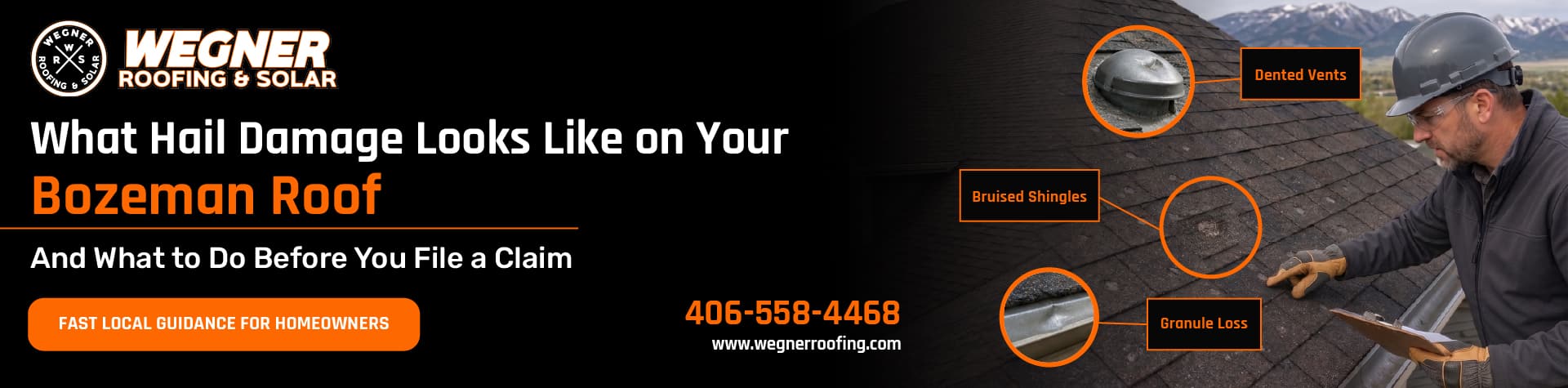
What Hail Damage Looks Like on Your Bozeman Roof And What to Do Before You File a Claim
Bozeman summers are stunning until a storm cell rolls off the Bridger Range and drops marble-to-golf-ball-sized hail across neighborhoods like Legends, Bridger Creek, and the Midtown District.
The Gallatin Valley sits in a geographic corridor that funnels some of Montana’s most intense summer convective storms, and your roof is the first line of defense.
Here’s what most homeowners miss: hail damage roof problems rarely look alarming from the street.
In 2026, Bozeman homeowners who skip the inspection end up paying $3,500–$18,000 out of pocket for repairs that a properly filed hail damage insurance claim would have covered.
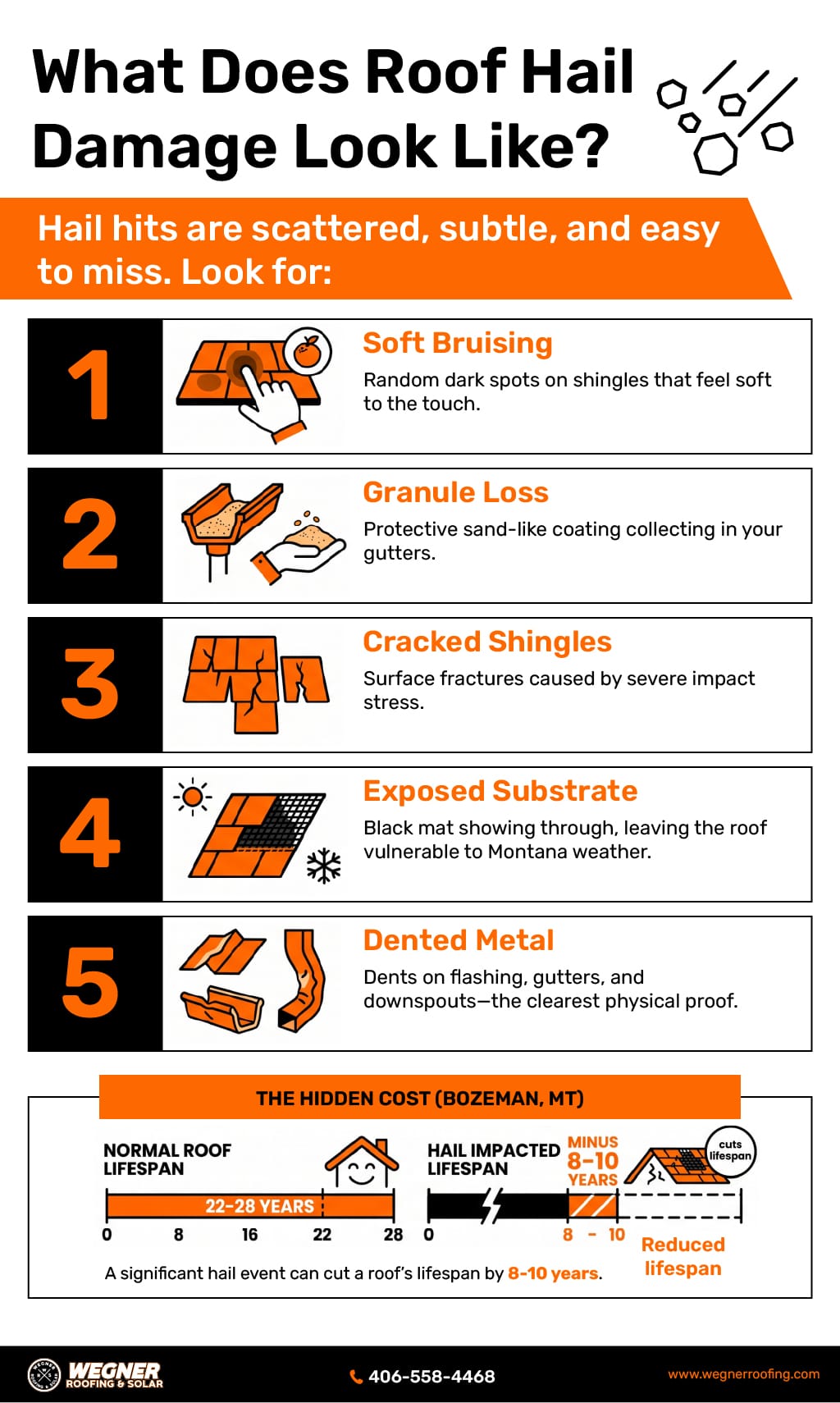
What Does Hail Damage Look Like on a Roof?
Unlike a missing shingle from wind, hail hits are scattered, subtle, and easy to dismiss.
Here’s what to look for:
- Random dark spots or soft bruising on shingles: Press them, and they feel like a bruise on fruit.
- Granule loss: The protective sand-like coating that collects in gutters after a hail storm.
- Cracked or split shingles: Occur where impact stress fractured the surface.
- Exposed black substrate: Visible beneath the granule layer, leaving the mat vulnerable to Montana’s UV and freeze-thaw cycles.
- Dented metal flashing, gutters, and downspouts: The clearest physical proof of hail damage on any property.
Asphalt shingles in Bozeman last 22–28 years under normal wear. A significant hail damage event strips granule protection and exposes the mat, cutting that lifespan by 8–10 years.
How to Check Your Bozeman Roof for Hail Damage
Start at Ground Level
After any hail storm, walk your entire property before making any calls.
Look for:
- Dented gutters, downspouts, or AC unit housings.
- Pitted or cracked window screens.
- Spatter marks across painted siding or wood trim.
These are ground-level indicators that your roof deserves a professional evaluation
Check Your Attic
Go into your attic during daylight. Visible light coming through the roof deck, or damp insulation, means storm impact has already penetrated the structure.
Get a Roof Inspection After a Hailstorm
This is the step most Bozeman homeowners skip, and the one that costs them the most.
A certified local Bozeman roofing contractor can distinguish functional damage from cosmetic damage, which is exactly what drives the outcome of your hail damage insurance claim.
In 2026, a professional roof inspection after a hail storm in Bozeman runs $150–$350. Many trusted local contractors offer this service for free following storm events.
Don’t guess. Get the damage on record, because assessing the difference between cosmetic and structural damage can be difficult.
Local teams like Wegner Roofing & Solar provide free hail damage roof inspections for Bozeman homeowners. Their certified team photographs and documents every impact point, so you enter your insurance conversation with professional evidence, not guesswork.
Claim your free hail damage inspection with Bozeman’s local experts at Wegner Roofing & Solar.
What to Do Before You File Your Hail Damage Insurance Claim
Filing a hail-damage roof insurance claim without proper preparation is one of the most costly mistakes Bozeman homeowners make.
Insurance adjusters are trained to identify documentation gaps.
Day 1: Document the Evidence Immediately
Filing a hail-damage roof insurance claim without proper preparation is one of the most costly mistakes Bozeman homeowners make.
Insurance adjusters are trained to identify documentation gaps.
Day 1: Document the Evidence Immediately
Take clear photos of every bruised shingle, granule-filled gutter, and dented downspout. Ensure your phone’s date and timestamp settings are enabled for proof.
Day 1-2: Verify Your Storm Date with NOAA
Cross-reference your timeline with official NOAA storm event data for Gallatin County. Montana insurers check this instantly, and an incorrect date can mean a swift denial.
Week 1: Get a Contractor's Written Report First
Have a licensed local roofer perform a comprehensive inspection. A detailed, independent structural report protects you against low-ball estimates from hurried adjusters.
File Promptly: Don't Wait.
Montana law requires property damage to be reported as soon as reasonably possible. Waiting 6+ months gives carriers an easy excuse to claim the damage happened post-storm.
Book a free digital storm assessment with Wegner in Bozeman, MT, now!
Key Takeaways
- Hail damage on a roof typically appears as bruising, granule loss, and cracked shingles, and it is rarely visible from street level.
- Dented gutters, downspouts, and AC covers are the first ground-level signs after a hail storm.
- A roof inspection after a hail storm in Bozeman costs $150–$350 in 2026; reputable contractors often offer it free.
- Always secure a licensed contractor’s written report before filing a hail damage insurance claim.
- NOAA storm records for Gallatin County can verify your claim, so match your storm dates precisely.
Don't Let a Bozeman Winter Turn Your Hail Damage Into a Full Disaster
A hail-damaged roof heading into a Bozeman winter is a liability that compounds fast.
January temperatures in the Gallatin Valley regularly drop to -10°F to -20°F, and every cracked shingle becomes an entry point for ice damming, moisture intrusion, and structural decay.
Hail damage that starts as surface granule loss in July can escalate to deck rot, saturated insulation, and ceiling water damage by February.
Homeowners who act early, document thoroughly, and file a clean hail damage insurance claim consistently recover more and spend far less out of pocket.
After major storm events, Bozeman’s top roofing contractors book 3–5 weeks out. Don’t wait for an active leak before you schedule your hail damage roof inspection.
Wegner Roofing & Solar is Bozeman’s Trusted Hail Damage Roof Specialists.
From free storm damage inspections to working side-by-side with your insurance adjuster, Wegner Roofing & Solar makes the entire hail damage roof claims process clear and manageable for Bozeman homeowners. You don’t have to navigate this alone.
Call Wegner Roofing & Solar in Bozeman now to schedule your free inspection!
FAQs About Hail Damage in Bozeman, Montana
What does hail damage look like on asphalt shingles?
Hail damage on asphalt shingles appears as random, circular bruises with granule loss, like bruised fruit.
Unlike directional wind damage, hail impacts scatter unpredictably across the roof, often requiring close-up inspection to confirm. Every mark tells a story of the storm.
How do you tell if your roof has hail damage in Bozeman?
Check gutters for shingle granules; they protect against UV and water, so accumulation means hail compromises your roof.
For definitive confirmation, schedule a free storm inspection with a licensed Bozeman contractor to assess true structural integrity rather than surface patterns alone.
Should I call a roofer or my insurance company first after a hail storm?
Call a licensed roofer first. Insurance adjusters typically spend 15–30 minutes on your roof, while a contractor documents everything in detail. Having a contractor’s damage assessment in hand gives your hail damage insurance claim a stronger professional foundation from the start.
Can you see hail damage on a roof from the ground?
Check your gutters and downspouts for granule accumulation, as that is your fastest ground-level indicator. Dented gutters and downspouts are also often visible from the ground after a hail storm.
However, functional hail damage, the kind that qualifies for an insurance payout, is typically invisible from street level and requires a hands-on inspection directly on the roof surface.
How big does hail need to be to damage a roof in Montana?
In Montana, hail measuring 1 inch in diameter, roughly the size of a quarter, can damage standard 3-tab asphalt shingles. At this size, the impact is strong enough to fracture the shingle’s internal fiberglass mat and loosen the protective granules.
Stones 1.5 inches or larger typically cause significant hail damage to the roof and impact architectural shingles, regardless of shingle age or current condition.
Table of Contents

Categories
Latest Posts
October 5, 2026
Commercial solar panel installation is a major building project, not just an equipment purchase. Before asking for a quote, property owners should understand the roof’s
October 2, 2026
Get clear answers to “do home warranties cover solar panels” and learn what’s included, excluded, and how to check your solar system’s coverage options.
October 1, 2026
Get clear answers on insurance window replacement, including what’s covered, claim steps, and how to handle costs for damaged or broken windows.
September 30, 2026
Get clear answers on commercial roofing insurance, including coverage types, costs, and claims. Learn what contractors and property owners need to know.