
- Family owned since 2011
Attic Condensation in Belgrade, MT: Causes, Signs & Fixes
2,000+
Five-Star Reviews
5,000+
Projects Completed
15 Years
In Business
24/7
Emergency Response
Belgrade Attic Condensation Explained: Causes, Signs, and Complete Fixes
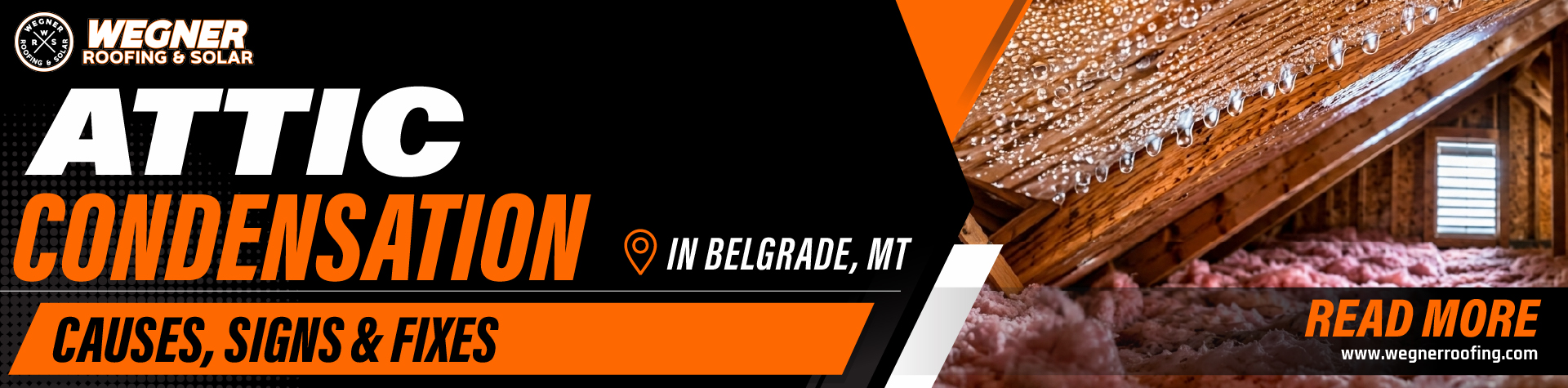
Gallatin Valley winters create severe risks for attic condensation in Belgrade homes. Between November and March, heated, humid air from your living area constantly drifts upward into unconditioned attic spaces. When this warm air strikes cold roof sheathing during a hard freeze, it immediately turns into frost, creating destructive wood rot, black mold growth, and leaking ceiling stains.
Solving this issue requires three synchronized solutions working together rather than a single patchwork fix. Homeowners need precision air sealing to block warm airflow at ceiling penetrations, balanced soffit and ridge ventilation to exhaust lingering humidity, and adequate Zone 6 insulation to keep roof temperatures uniformly cold. Skipping any of these steps allows persistent moisture problems to continue ruining structural roof decks.
Protect your roof deck from costly winter decay before the next major freeze hits. Reserve a fully documented attic inspection with Wegner Roofing & Solar to identify hidden moisture paths and ensure your property stays completely dry all season long.
Why Belgrade's Climate Makes This Worse Than Other Montana Markets
Belgrade sits in a specific pocket of the Gallatin Valley that combines three conditions most other regional markets don’t get in the same combination: roughly 70 inches of annual snowfall, sustained freeze-thaw cycling where daytime highs climb above freezing and nighttime lows drop back below it, and wind gusts of 40 to 60 mph during spring and fall that pull warm attic air out through gable vents faster than intake vents can replace it. That last point matters more than most homeowners realize, a wind-driven pressure imbalance in the attic can pull conditioned air up through can lights and attic hatches even in a well-insulated home, feeding the very moisture problem you’re trying to prevent.
7 Warning Signs of Attic Condensation Belgrade Homeowners Miss
Most condensation damage isn’t caught until it’s already cost someone a section of roof deck. Here’s what to check before winter, in order of how often we find it during a free roof inspection in Gallatin County:
- Frost on the underside of the roof deck. On a cold morning, this looks like a fine white coating on the plywood or OSB between rafters. It melts by mid-morning as the attic warms, which is exactly why homeowners miss it, check before 9 a.m. in January.
- Musty odor near the attic hatch. This is almost always mold colonizing damp insulation or sheathing, not a one-time smell.
- Rusted or “popped” roofing nails. Condensation corrodes nail shanks from the inside of the attic, causing them to back out and eventually puncture shingles from underneath.
- Ice dams at the eaves. We see this constantly in Springhill and Countryside Estates, where higher wind exposure combines with attic heat loss to melt snow unevenly across the roof plane.
- Water stains on ceiling drywall with no active roof leak. If your roofer confirms the shingles and flashing are intact but you still have staining, condensation dripping from the underside of the deck is the likely source.
- Sagging or compressed insulation. Wet fiberglass batts lose most of their R-value and compact under their own weight — a visual cue that moisture has already been present for at least one season.
- Visible daylight or drafts around bath fan housings. If you can feel air movement around a bathroom exhaust fan from the attic side, that fan is likely pulling humid air into the attic space instead of venting it outside.
What Causes Attic Condensation in Belgrade Homes
The Problem of Inadequate or Unbalanced Attic Ventilation
According to the International Residential Code (IRC), the standard baseline for attic ventilation is 1 square foot of net free ventilation area per 300 square feet of attic floor space. For optimal airflow, this space must be divided equally between:
- Intake Ventilation: Typically soffit vents.
- Exhaust Ventilation: Typically ridge or gable vents.
Why the Bare Minimum Falls Short in Belgrade
Many homes in Belgrade were built to meet only this strict code minimum, specifically builder-grade houses constructed during the 2000s development boom in Antelope Ridge.
Unfortunately, relying solely on the baseline standard fails to account for additional heat loads that commonly get trapped in the attic space. This excess heat is frequently generated by:
- Recessed “can” lighting fixtures extending into the attic.
- HVAC ductwork routed directly through the space.
- New home additions that connect to the existing attic structure.
Air Leaks From the Living Space
Warm air escapes into the attic through the least obvious paths: recessed can lights without airtight housings, the attic access hatch itself, plumbing stack penetrations, and top plates where drywall meets exterior walls. A single uninsulated, unsealed attic hatch can leak more warm, humid air into an attic than several square feet of poorly performing insulation.
Under-Insulated Older Homes
Belgrade Gardens homes built before current attic ventilation standards were well understood typically carry 6–8 inches of older fiberglass batt insulation, roughly R-19 to R-25. Gallatin County sits in IECC Climate Zone 6, where the Department of Energy recommends R-49 to R-60 for attic insulation. That gap means these attics run warmer than they should, which raises the interior surface temperature unevenly across the roof deck and creates the exact temperature differential condensation needs.
Bath and Kitchen Fans Vented Into the Attic Instead of Outside
This is the single most common defect our Belgrade roofing experts find during attic inspections, and it is almost invisible without getting up there. A bathroom exhaust fan that terminates in the attic space instead of through a roof or wall cap dumps a shower’s worth of humid air directly into the attic every single time it runs, often for years before anyone notices the resulting mold pattern on the nearby rafters.
A real-world example: On a 2014-built home in Antelope Ridge, the homeowner called about a musty smell that only appeared in late winter. The roof deck showed heavy staining in a roughly six-foot radius around one spot, directly above the master bathroom. The exhaust fan duct had never been connected to the roof vent cap; it was simply blowing into open attic space behind an insulation baffle. Sealing that single connection, combined with adding two soffit vents to correct the intake-to-exhaust ratio, resolved the moisture pattern within one winter season.
How We Diagnose Attic Condensation in Gallatin County
Step 1: Attic-Level Inspection (30 to 45 minutes): We physically enter the attic, not just view it from the hatch, checking sheathing, insulation depth, baffle placement, and every penetration point for air leakage.
Step 2: Ventilation Ratio Calculation: We measure your attic square footage and existing net free ventilation area against the 1:300 (or 1:150 for attics without a vapor barrier) code standard, then identify whether the imbalance is on the intake or exhaust side.
Step 3: Moisture and Insulation Assessment: We check insulation depth against the R-49 to R-60 Zone 6 target and identify any compressed, wet, or mold-affected sections that need replacement rather than supplementation.
Step 4: Written Findings: You get a documented report with photos before any work is recommended. This is the same honest-assessment standard we at Wegner Roofing & Solar apply across every inspection as your trusted Belgrade MT roofing contractor.
How to Fix Attic Condensation: The Correct Order of Operations
Doing these out of sequence wastes money. Adding ventilation before sealing air leaks, for example, can pull more conditioned air into the attic rather than less.
- Seal air leaks from living space first (Day 1). Foam or caulk around can lights, plumbing stacks, and the attic hatch. This is the cheapest step and the one most contractors skip.
- Correct bath and kitchen fan venting (Day 1 to 2). Reroute any duct terminating in the attic to a proper roof or wall exhaust cap.
- Balance intake and exhaust ventilation (Day 1 to 3, weather permitting). Add soffit vents or a continuous ridge vent system to hit the 1:300 ratio — our roof ventilation team calculates the exact square footage needed for your attic before installing anything.
- Bring insulation up to Zone 6 standard (Day 2 to 3). Once air sealing and ventilation are corrected, add or replace roof insulation to reach R-49 to R-60, removing any mold-affected material first.
- Monitor through one full winter (ongoing, no cost). A quick attic check in January after the first sustained cold snap confirms whether frost has stopped forming. We recommend this as a courtesy follow-up call for our winter installs.

Attic Condensation Solutions by Belgrade Neighborhood
- Springhill & Countryside Estates: Elevated, wind-exposed lots mean gable and ridge exhaust vents move air fast, sometimes too fast relative to intake. We typically add soffit intake here rather than reduce exhaust.
- Belgrade Gardens & Beaumont Greens: Older housing stock (1980s and earlier) usually needs the full sequence of air sealing, insulation depth correction, and often a full ventilation retrofit, since many of these attics predate current code minimums entirely.
- Antelope Ridge & Prescott Ranch: Newer construction generally has adequate insulation depth but frequently has the bath-fan-into-attic defect described above. Rapid-build subdivisions from the 2000s to 2010s sometimes cut corners on duct terminations that inspectors do not always catch.
While addressing your interior attic ventilation and moisture control, it is equally important to ensure your exterior roof is prepared for severe weather. For more on protecting your property from the outside in, read our guide on Belgrade, MT Hail Season: Why You Should Book a Roof Inspection Before the Next Storm.
Attic Condensation vs. Roof Leak: How to Tell the Difference
Signal | Attic Condensation | Active Roof Leak |
Timing | Appears after cold nights, especially Nov–March | Appears during or right after rain/snowmelt |
Pattern | Diffuse frost or staining across a wide roof plane | Isolated stain, often traceable to a penetration or valley |
Smell | Musty, persistent | Often no odor unless long-standing |
Nail condition | Rusted, backed-out nails common | Usually unaffected unless leak is chronic |
Fix | Air sealing, ventilation, insulation | Flashing repair, shingle replacement, deck repair |
If you are not sure which issue you are dealing with, that is exactly what a roof inspection from our Belgrade team is for. Whether it is a slow moisture problem or a sudden leak requiring an emergency roofing contractor, guessing wrong means paying for the wrong fix.
What It Costs to Fix Attic Condensation in Belgrade, MT
Ventilation corrections, like adding soffit intakes or replacing ridge vents, are typically your most affordable starting point. Based on verified 2026 pricing data, professional attic ventilation improvements generally range between $1,500 and $5,000.
If your home requires insulation upgrades to meet the R-49 to R-60 Zone 6 target, expect costs around $1 to $4 per square foot installed, bringing average projects to roughly $1,000 to $4,500. A full roof replacement only becomes necessary if condensation goes ignored long enough to rot the structural roof deck, making early detection of frost and musty odors essential.
Please note that these 2026 cost figures are national averages intended strictly for general guidance. Your exact final price will vary significantly based on your specific attic square footage, material choices, and if old insulation requires removal.
Every estimate from our Belgrade roofing contractor is fully written and clearly itemized. You will know exactly which specific combination of air sealing, ventilation, or insulation your property actually needs to stay protected.
Frequently Asked Questions
What temperature causes attic condensation?
Condensation forms whenever attic surface temperatures drop below the dew point of the air inside the attic, typically when indoor air near 68 to 70°F meets roof sheathing below 20°F, a common gap during Belgrade’s winter cold snaps. Proper ventilation and air sealing prevent that warm, moist air from reaching the cold surface in the first place.
Can attic condensation cause mold?
Yes. Persistent moisture on sheathing or insulation creates the exact conditions mold needs, organic material, moderate temperatures, and standing humidity. Mold can begin colonizing exposed wood or insulation within 24 to 48 hours of sustained dampness if the underlying ventilation or air-sealing issue isn’t corrected.
Is attic condensation covered by homeowners insurance?
Generally, no. Condensation is classified as a maintenance issue rather than a sudden, accidental event, so most standard Montana homeowner policies exclude it. This is different from storm or hail damage, which is typically covered, our team can help you distinguish between the two during an inspection.
How much ventilation does a Belgrade attic need?
Code minimum is 1 square foot of net free ventilation area per 300 square feet of attic floor, split evenly between soffit intake and ridge or gable exhaust. Homes without a proper vapor barrier should follow the stricter 1:150 ratio to account for additional moisture movement.
Will a dehumidifier fix attic condensation?
No. A standalone dehumidifier treats a symptom without addressing the air leaks or ventilation imbalance causing warm, moist air to reach the attic in the first place. It can reduce humidity temporarily but won’t stop frost from reforming on cold surfaces.
How do I know if my Belgrade attic has enough insulation?
Zone 6 climate standards, which cover Gallatin County, call for R-49 to R-60 in attic spaces, roughly 14 to 18 inches of blown-in fiberglass or cellulose. If your current insulation is compressed, discolored, or sits at 6 to 8 inches, it’s below the recommended level for our climate.
Secure Your Roof Against Winter Moisture Damage
Gallatin Valley freeze and thaw cycles will not wait for you to notice a musty smell in February. Ignoring early warning signs of attic condensation allows severe structural decay to spread silently directly above your ceiling. If you spot frost clinging to your roof deck, notice a persistent damp odor, or see thick ice building along your eaves, immediate action is required to prevent costly deck rot.
Stop guessing about the structural health of your home. Wegner Roofing & Solar provides comprehensive, fully documented attic inspections for Belgrade and Gallatin County homeowners. We deliver the exact evidence-based diagnostics detailed on our local service pages to pinpoint your specific moisture problems. Reach out now to protect your property and budget before the next hard freeze hits.
Get Your Free Estimate
