Why Every Day Matters During April Storms
Bozeman averages 89 inches of snowfall annually. That seasonal weight stresses your roof structure for months, and the snow load roof damage Bozeman homeowners experience doesn’t always show up as obvious sagging.
It hides as:
- Cracked roof decking beneath the shingles
- Failed flashing seals at pipe boots and valleys
- Buckled gutters that only reveal themselves when Bozeman’s hail season rain finally finds the entry points
Gallatin County spring storms regularly produce hailstones measuring 1.5 to 1.75 inches in diameter, enough to crack asphalt shingles, breach metal flashing, and reduce a standard 25-year roof’s lifespan by 5 to 8 years.
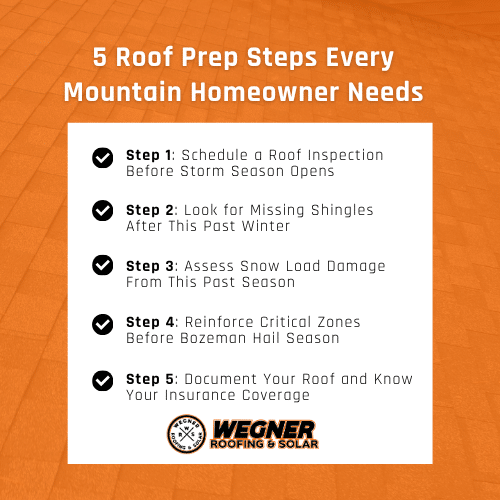
Step 1: Schedule a Roof Inspection Before Storm Season Opens
A professional roof inspection before storm season is the highest-ROI move a Bozeman homeowner can make in late winter.
Asphalt shingles in Bozeman’s climate last 20 to 25 years under ideal conditions, but winter snow loads and spring hail cycles routinely cut that lifespan to 15 years without proper maintenance.
A certified inspector catches issues invisible from the street, including:
- Soft decking spots caused by moisture trapped under shingles.
- Granule loss on shingle surfaces that signals UV and impact degradation.
- Cracked pipe boot seals one of the most common Bozeman leak entry points.
Booking your inspection immediately locks in standard pricing before Bozeman storm season roofing demand pushes contractor wait times to 4 to 6 weeks during peak season.
Schedule your free roof inspection with Wegner Roofing & Solar, which has served the community since 2011. Don’t wait until the hail is already falling.
Step 2: Look for Missing Shingles After This Past Winter
Missing shingles after storm events are the most visible warning signs, but Bozeman homeowners lose shingles quietly, too, lifted by winter Chinook winds or separated by ice-dam pressure building along roof eaves.
Here is what to look for on your next walkthrough:
- Granule buildup collects in your gutters after rain or snowmelt.
- Shingle tabs or fragments in your yard or near your downspouts.
- Exposed black underlayment is visible on any slope, creating a direct path for water intrusion.
Each missing shingle is an active entry point for Bozeman hail season wind-driven rain. The earlier you catch it, the cheaper the fix.
A single shingle repair typically costs $150 to $350, versus $1,500+ once water reaches the decking.
Step 3: Assess Snow Load Damage From This Past Season
Wet Montana snowpack reaches 20 to 25 pounds per cubic foot. Residential roofs in Gallatin County are typically engineered to handle 40 to 50 psf according to the City of Bozeman structural design criteria, but repeated seasonal loads create cumulative structural fatigue that isn’t always visible.
Watch for these structural red flags:
- Interior doors that suddenly stick or won’t latch are a sign that the frame is shifting.
- Hairline cracks in ceilings or drywall near exterior walls.
- A “wavy” roofline when viewing your home from the street.
These aren’t just cosmetic issues. There are signs that your roof’s skeleton is tired and may not withstand a heavy 2026 hail event.
Snow load roof damage that Bozeman homeowners overlook in late winter often becomes the reason for a full residential roof replacement by July.
Step 4: Reinforce Critical Zones Before Bozeman Hail Season
Preparing your roof for storm season in Montana means going beyond shingle checks. The most vulnerable zones on any Bozeman home include:
- Flashing at chimneys, skylights, and valleys is the #1 source of storm-related leaks
- Pipe boot seals rubber boots crack in Montana’s freeze-thaw cycling faster than any other component
- Ridge cap shingles are exposed to direct wind uplift and hail impact at the highest point of your roof
Properties in Cattail Creek and the Legends subdivision, many built between 1998 and 2012, are particularly prone to flashing failure under high-impact hail conditions.
Wegner Roofing & Solar recommends upgrading to Class 4 impact-resistant shingles. These shingles are engineered to withstand significant hail impact and often qualify homeowners for insurance premium discounts.
Explore Wegner Roofing’s storm damage repair services, including emergency response for Gallatin Valley homeowners after severe weather events.
Step 5: Document Your Roof and Know Your Insurance Coverage
Before the Bozeman storm season, roofing damage occurs; documentation is your most powerful financial protection tool.
Insurance adjusters calculate depreciation based on pre-storm condition. Without photos, you lose negotiating power.
Here is how to document your roof correctly:
- Photograph every slope front, back, and both sides in clear daylight.
- Capture close-ups of all flashing, seams, and penetrations.
- Date-stamp every image using your phone’s GPS metadata feature.
- Save images in cloud storage so they’re accessible during any future claim.
Montana homeowner policies increasingly include cosmetic damage caps and hail exclusions.
The Wegner Roofing team in Bozeman walks homeowners through the full insurance claims process from damage inspection to final settlement, ensuring fair treatment from your carrier.
Your 2026 Roof Either Survives Storm Season or It Doesn’t | Preparation Decides Which
The most expensive Bozeman storm season roofing repairs are always the ones that could have been prevented.
Gallatin County’s 2026 spring hail outlook points to above-average storm frequency, and the homeowners who act in February and March will be the ones with dry ceilings in June.
Wegner Roofing & Solar has served Bozeman and the full Gallatin Valley since 2011.
Whether you need a post-winter inspection, critical zone reinforcement, or emergency storm damage repair in Bozeman, their local team knows exactly what Montana roofs face every spring.
Find Wegner Roofing & Solar on Google Maps and see why Gallatin Valley homeowners trust them year after year.
Don’t let the 2026 storm season catch your roof unprepared. Contact Wegner Roofing & Solar and book your free Bozeman roof inspection today, before the first hailstone of spring drops on an unprotected roof.

FAQs about Storm Season Roofing in Bozeman
When is storm season in Bozeman?
Bozeman’s storm season runs March through June, averaging 12 to 18 significant hail events annually.
April typically sees the most intense storms, especially north of downtown near Bridger Bowl Road. Residents in zip codes 59715 and 59718 should remain particularly vigilant.
How do I prepare my roof for hail in Montana?
Install Class 4 impact-resistant shingles (UL 2218 rated) for the best long-term protection. Many Montana insurers offer 15 to 20 percent premium discounts for these installations.
Utilizing high-performance materials provides measurable, insurer-recognized safety for your home during the upcoming storm season.
Does snow load damage roofs in the mountains?
Yes. Heavy snow causes ridge deflection, rafter fatigue, and ice dams. In Bozeman, the spring melt-refreeze cycle is the primary driver of shingle failure and underlayment separation, particularly on north-facing slopes.
Professional inspections help identify these structural issues before spring rains.
Should I get a roof inspection before summer?
Yes. A professional inspection evaluates critical checkpoints like flashing seals, granule retention, and gutter stability.
A written report identifies hidden winter damage and provides essential documentation for insurance claims, ensuring you have undisputed proof of your roof’s condition before summer storms hit.