
Key Takeaways
- Start with the building’s roof history, access rules, and records before setting a maintenance calendar.
- Match professional reviews and safe observations to the roof system, building use, weather exposure, and documented conditions.
- Pay close attention to drainage, seams, edges, penetrations, interior moisture clues, and work by other trades.
- Keep a dated maintenance log so property owners can describe concerns clearly and decide when a qualified assessment is needed.
Commercial roof maintenance is easiest to manage when it is a repeatable process, not a scramble after a ceiling stain appears. A practical program helps property owners spot changes, keep drainage paths in working order, and decide which concerns need a closer look. The right plan depends on the roof system, building use, weather exposure, access, and the records already available. For a commercial property in Montana, North Dakota, or South Dakota, local weather and access conditions should inform that plan without replacing a building-specific assessment.
Discuss a commercial roofing concern
Start with the building and the roof’s history
Before setting a calendar reminder, gather what is known about the building. A roof is not an isolated surface. It works alongside drains, gutters, downspouts, walls, doors, rooftop equipment, insulation, and the spaces below. A leak that appears in one room might relate to a detail some distance away, while condensation or plumbing can sometimes resemble a roof leak. A useful maintenance program records observations without assuming the cause before it has been investigated.
Start with basic documents that may be available:
- The roof plan or drawings, including known additions and changes.
- Installation or replacement records, if available, including the roof system and approximate work dates.
- Past inspection notes, repair invoices, warranties, and contractor scopes.
- Records of recurring leaks, interior staining, ponding, or drainage concerns.
- Information about rooftop units, vents, skylights, signs, solar equipment, and other roof penetrations.
- Building access procedures, safety requirements, and the person responsible for approving work.
These records do not need to be perfect to be useful. If a file is missing, mark it as unknown rather than filling the gap with a guess. Note the date of each observation and who supplied it. A future roofer can then separate documented history from assumptions and ask for the missing details that matter.
Also describe how the building is used. A warehouse with limited roof traffic has different access patterns from a facility with frequent service visits to rooftop equipment. A retail or office building may need work scheduled around customers, tenants, deliveries, or sensitive operations. Maintenance timing and access controls should reflect those realities.
Choose a cadence that fits the roof
There is no single inspection schedule that fits every commercial roof. A reasonable starting point is to arrange professional reviews on a regular, documented schedule and add observations after significant weather or building work. The appropriate frequency depends on the roof’s condition, system, age and history, drainage layout, exposure, warranty terms, and the owner’s ability to safely observe it. Ask a qualified roofing professional to recommend a schedule for the specific property instead of treating a general interval as a guarantee.
Between professional reviews, a facility manager can keep a simple log of conditions visible from safe ground-level locations or other authorized vantage points. Record interior symptoms, blocked or overflowing drainage observed from the ground, and work performed by other trades. Do not climb onto a roof or open a hatch unless the owner has authorized the access and the person is trained and equipped to follow the building’s safety procedures.
Consider an additional review after events that could change roof conditions. Examples include severe wind, hail, heavy rain, snow or ice accumulation, nearby construction, installation or service of rooftop equipment, and any work that involved roof access. A weather event does not prove roof damage, and a lack of visible damage from the ground does not establish that every roof detail is unaffected. The purpose of a follow-up is to document what can be observed and decide whether a closer professional assessment is appropriate.
When planning a calendar, account for local seasons and access conditions. A commercial property in Montana may need a different observation plan from one in North Dakota or South Dakota. While Iowa and Tennessee bring their own combinations of wind, rain, hail, heat, cold, snow, and freeze-thaw conditions. Owners can review Wegner’s service-area information for the company’s advertised regional footprint, then base the maintenance schedule on the actual property exposure. Roof history, and written scope rather than assuming a statewide pattern tells the whole story.
Build a seasonal checklist without guessing at conditions
A seasonal checklist can help a property manager remember recurring tasks, but it should be adjusted to the building and approved inspection plan. Do not treat the season itself as proof of damage or as a reason for unsafe roof access. Use it to ask what has changed, what should be checked from a safe location, and whether a professional review is due.
Before the wet or stormier part of the year
Review recent inspection notes and open repair items. Confirm who receives reports of water entry and who can authorize a contractor visit. Check, from safe accessible locations, whether gutters and downspouts appear to be obstructed or disconnected. If the property has a history of overflow or interior moisture, make sure that history is clearly described in the maintenance log. Ask a roofer whether the drainage and flashing areas identified in earlier reports need professional attention.
Where heavy rain, wind, or hail is a concern, remind staff how to report symptoms and where to find building emergency procedures. This is a communication step, not a prediction about weather or a claim that every storm creates roof damage. Avoid staging tools, sealants, or loose materials on the roof for an untrained employee to use after a storm.
After an event or a period of difficult weather
Follow the building’s incident process. After a hail or wind event in Montana, North Dakota, or South Dakota. The same safe-documentation approach applies: check for interior signs from safe locations and record reports from occupants. Note when the event occurred, what was observed, and whether the roof was accessed by any trade before or after it. If an area is wet, unstable, or otherwise hazardous, keep people away and arrange a qualified assessment. An owner’s role is to document and coordinate, not to attempt a risky roof walk to get a closer photograph.
When a contractor reviews the property, ask whether the visit was limited to a particular concern or included a broader roof assessment. The scope matters: a localized leak investigation may not include every roof section, just as a general review may not identify a concealed condition. Record the limits stated in the report and any recommended follow-up.
Before colder conditions or restricted access
Use available access windows to address known, approved maintenance and clarify who to contact if an interior issue arises when roof access is limited. Review whether temporary measures remain in place and whether they need professional follow-up. Do not assume that a temporary patch, a dry ceiling, or the arrival of cold weather resolves the underlying question.
Snow and ice can obscure roof details and create hazardous surfaces. Maintenance plans should identify who decides whether conditions allow an inspection and what alternative observations can be made from inside or at ground level. Document anything that cannot be assessed rather than marking the item complete. The same principle applies during heat, high winds, or other conditions that make roof access unsafe.
Adapt the checklist to the roof system
The phrase “commercial roof” covers different assemblies. A building can have a low-slope membrane roof, metal roofing, a steep-slope area, or more than one system across additions and adjoining structures. The system affects which details a professional will inspect and what kind of maintenance is appropriate. If the system is unknown, use records or ask a roofer to identify it instead of selecting products or repair methods based on appearance alone.
- Low-slope membrane areas: Ask how the professional will review visible field material, seams, perimeter conditions, flashing, drains, and penetrations. Keep notes about recurring water observations or foot traffic. Do not puncture, probe, or apply a coating without a system-specific recommendation.
- Metal roof areas: The inspection may need to consider panels, seams, fasteners, flashings, transitions, and drainage paths as appropriate to the design. Record any loose-looking or displaced detail for review. Avoid tightening fasteners or applying a sealant based on a visual guess; the right action depends on the assembly and the observed condition.
- Steep-slope portions: Note the type of material if known, roof intersections, valleys, edge conditions, and visible penetrations. A ground-level view can identify a missing or visibly displaced piece but cannot establish the condition of every roof surface. Leave roof-level review to qualified people using safe access procedures.
- Mixed or modified roofs: Add each section to a simple roof plan and identify where an addition, transition, or equipment project changed the assembly. A repair approach that works on one area may not suit an adjoining roof section.
Ask the roofing professional to distinguish routine observations from work that requires a repair authorization. The plan should state what the owner’s staff may safely observe, what a contractor will inspect. And what must be referred to the manufacturer or another specialist if applicable. This avoids turning a generic list into instructions to handle materials or alter a roof without the necessary knowledge.
Also confirm whether a roof contains special features or restrictions. Examples could include rooftop equipment, skylights, access hatches, guarded zones, fragile surfaces, or areas where work must be coordinated with tenants. The property manager should communicate known hazards and access limits before a visit. The contractor should explain any limitations encountered during the visit and note areas not inspected.
Check drainage before water becomes an interior problem
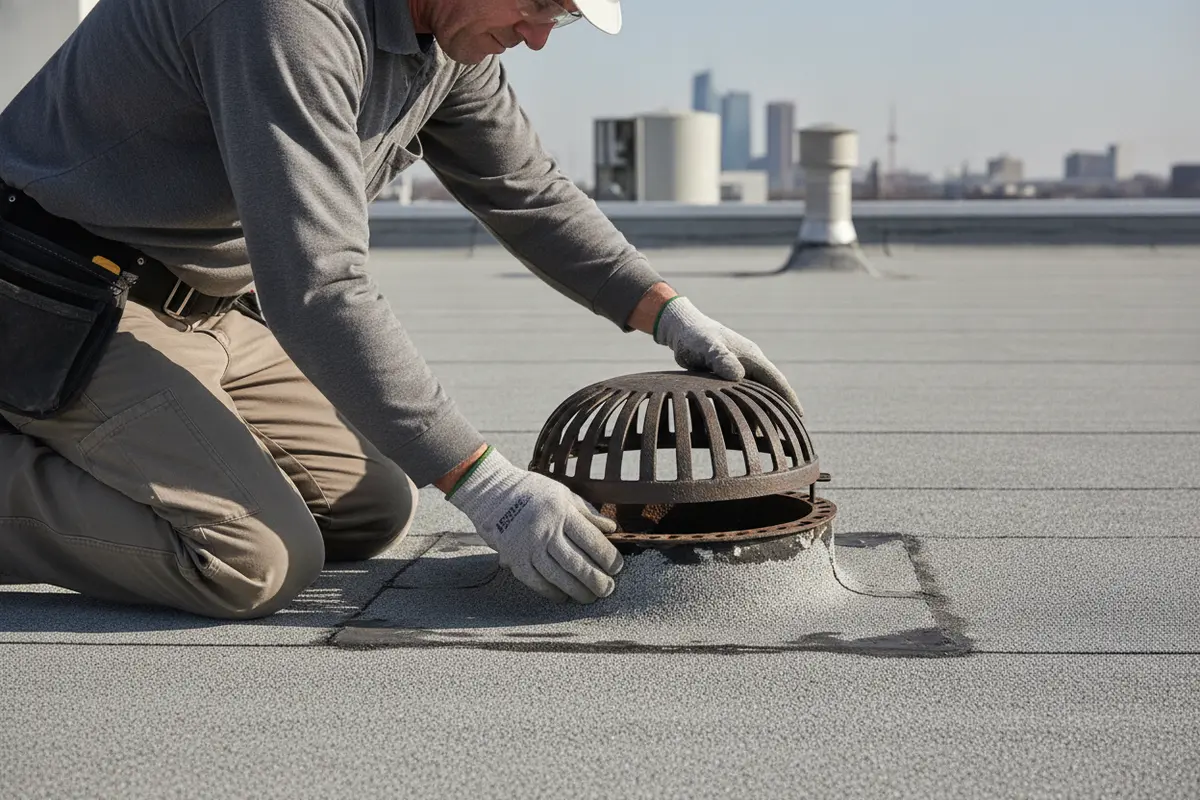
Water management deserves consistent attention because drainage components connect the roof surface to the building’s exterior water path. Depending on the building, those components may include internal drains, scuppers, gutters, downspouts, and outlets. Leaves, windblown debris, sediment, or material left by other work can obstruct flow. A blocked or damaged component can contribute to water backing up or spilling where it should not go.
During a planned review, note the location and condition of visible drains and outlets. Look for debris, displaced or damaged covers, signs of overflow, and material collecting in low areas. Check accessible gutters and downspouts from a safe position for visible obstruction, separation, or discharge that appears to be directed toward the building. The exact inspection methods depend on system design and safe access; do not remove components or enter confined areas as a routine maintenance shortcut.
After rain, a record of where water was observed can help a roofer understand the situation. Note the approximate time, rainfall context if known, affected location, and whether the water was still present later. A puddle seen once does not by itself establish that a roof is failing, and not all water conditions can be evaluated from a photograph. A professional should assess whether the observed condition is expected for the system or requires correction.
Keep drainage work specific. Clearing a visible obstruction is not the same as repairing a drain, changing roof slope, or correcting a larger water-management issue. If an outlet is loose, a drain repeatedly clogs, water regularly overflows, or ponding appears persistent, document the location and ask for an assessment. Avoid poking, cutting, or applying sealant to a roof surface in an attempt to make water disappear. An improvised change can obscure the source or create a new problem.
Pay attention to seams, edges, and penetrations
Commercial roofs include transitions and details where a roof meets another building element. Depending on the design, these can include seams, flashing, parapet walls, curbs, vents, skylights, access hatches, pipes, and rooftop equipment. These areas deserve observation because movement, weather exposure, service visits, and aging can affect them. A visual note is a reason to ask questions, not a diagnosis of the underlying assembly.
For a low-slope roof, a professional may consider the condition of visible membrane, seams, flashings, perimeter edges, and drainage details. Metal roofs have their own panel, fastener, flashing, and water-shedding details. Steep-slope sections can have shingles or other materials, valleys, edge metal, and penetrations. The right inspection checklist should be tied to the installed system; do not apply one system’s repair method to another.
Record what is actually visible. Examples include a loose-looking edge, a sealant area that appears cracked or separated. A damaged or missing component, debris around a penetration, or evidence that equipment work disturbed the roof. Avoid pressing on a membrane, pulling at flashing, walking on materials, or testing a seam by hand unless a qualified person directs the inspection. A surface can look sound while a hidden issue exists, and some apparent defects may not be active leaks.
Roof penetrations merit coordination. HVAC technicians, electricians, solar crews, sign installers, and other trades may need access. Before work begins, clarify who is authorized to access the roof, who is responsible for protecting it, and who will document any disturbance or repair. Keep a record of the work date, contractor, equipment involved, and any roof details changed. If the building is considering a roof project alongside solar or other equipment. Ask the appropriate professionals to discuss the roof’s condition, attachment approach, access, and future maintenance responsibilities before work is scheduled.
Look for clues inside the building, too
Interior observations can help narrow down when and where to investigate. Facility staff may notice ceiling stains, damp materials, peeling finishes, a musty odor, dripping, or recurring moisture near a wall or roof opening. Record the room, approximate location, date, recent weather if known, and whether the symptom changed over time. Photos can make a log more useful when they show a consistent location and include a reference point.
Do not assume every interior moisture symptom comes from the roof. Plumbing, mechanical equipment, condensation, and other sources can produce signs that appear similar. Note nearby pipes, units, or building features that might be relevant, and share the information with the person assessing the issue. If water is near electrical equipment, sensitive materials, or occupied areas. Follow the building’s emergency and safety procedures first; protect people and operations rather than trying to investigate a hazardous location.
A short timeline is often more helpful than a single description. For example: “A stain appeared below the northwest mechanical room after rain on Tuesday; it was dry during the previous week. The HVAC contractor accessed the roof on Monday.” This gives a roofing professional context without claiming a cause. Keep the original note even if the issue later dries, because recurring symptoms may follow a weather pattern.
Make weather observations useful
Weather can prompt a review, but it cannot substitute for one. After a storm, begin with safe observations: check for interior symptoms, look for visible debris or displaced components from the ground, and note any water reported by occupants. Keep people away from damaged areas and follow emergency procedures when conditions are unsafe. Do not climb onto a wet, icy, or storm-damaged roof to take pictures.
If hail or wind is suspected, record the date and the basis for the concern. This may include a storm report, occupant observation, exterior damage, or a roof concern seen by a qualified professional. Do not state that the roof has storm damage based only on a weather alert. Nor should an owner make a coverage or claim decision from an informal visual check. A roofer can document visible roof conditions; insurance coverage, claim approval, and policy interpretation are matters for the insurer and the applicable policy process. Owners who want to understand the contractor-side conversation can review Wegner’s roofing and exterior services, then confirm the appropriate scope for the specific building.
In cold weather, keep observations grounded in what can be safely seen. Snow, ice, and freeze-thaw conditions can restrict access and affect what an inspection can establish. Do not chip ice, apply chemicals, or use improvised tools on roof materials unless the system manufacturer or a qualified professional has directed an appropriate method. Record interior symptoms and access limits, then arrange assessment when conditions permit.
Keep a maintenance log that can guide action
A maintenance log turns scattered conversations into a usable history. It can be a spreadsheet, a building-management record, or another consistent system. The format matters less than making each entry clear enough for someone else to understand later.
For each inspection, observation, or repair, record:
- Date and approximate time, plus the person or company who made the observation.
- Roof area or interior location, using a plan, grid, compass direction, or fixed landmark.
- What was observed, described plainly without assigning an unconfirmed cause.
- Weather or recent events that may provide context, if known.
- Photographs from a safe, authorized position, when useful.
- Whether the condition is new, recurring, unchanged, or not yet compared with prior records.
- Any temporary measures, who approved them, and whether follow-up is still needed.
- Work scope, materials or components addressed, contractor, and completion date when repairs occur.
- Open questions, next steps, and the person responsible for checking that they are completed.
Label images with a date and location rather than relying on memory. If there are multiple roof sections, use the same naming convention each time. Keep original inspection reports and work documents together with the log. Do not treat a photograph as a substitute for a written scope or a professional’s inspection findings.
Keep records understandable to the next person
Property teams change, and repairs may happen years apart. Use ordinary language in notes and define any shorthand so a new manager can follow the history. Save the final report, not only the email that announced a visit. If a contractor issues a revised scope, keep both the earlier and final versions with a note about which was approved. For a multi-building property, identify the building and roof section in every file name.
When a repair is completed, compare the closeout information with the approved scope. Record any change that was authorized during the work and save the final description, invoice, photographs, and any product or workmanship documents supplied. If there is remaining work, a temporary condition, or a recommendation for later observation, assign an owner and a follow-up date. This simple closeout helps prevent an unfinished item from disappearing into an old email thread.
Keep manufacturer and contractor documents together, but do not infer coverage or warranty status from a folder label. Terms and requirements vary by product, project, and written agreement. Ask the relevant provider what documents apply to the specific roof, what maintenance or reporting responsibilities are described, and whom to contact with a question. Do not assume that a maintenance log proves coverage or that a repair is covered without review of the governing documents.
A useful record system also preserves uncertainty. If a report says that the source of moisture is undetermined, keep that wording. If a repair was recommended but not approved, mark it as open. This prevents later staff from treating a suggestion as completed work or a suspected cause as a confirmed finding.
Turn findings into repair priorities
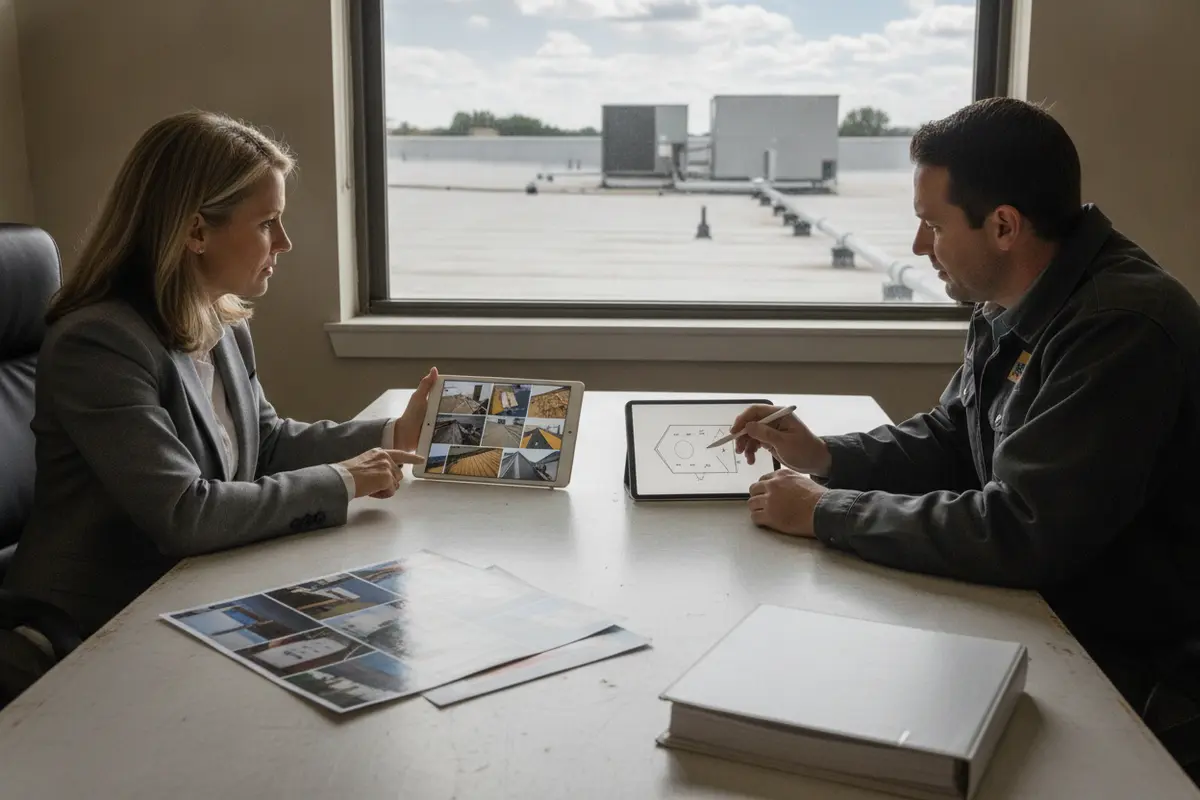
Not every observation needs the same response. A useful review separates urgent safety or active water concerns from conditions that can be tracked or scheduled. Ask the roofing professional to explain the observed condition, what evidence supports the recommendation, and what could happen if the work is delayed. If the condition’s cause is uncertain, ask what further inspection is needed before authorizing a permanent repair.
As an initial organizing method, group findings into three practical buckets:
- Immediate attention: an active leak, a loose or displaced component that could pose a safety risk, or an issue affecting occupants, equipment, or operations. Follow building safety procedures and arrange an appropriate prompt assessment.
- Planned repair: a documented concern that is not currently disrupting the building but should be corrected or evaluated within a recommended timeframe. Ask the contractor to explain the priority and dependencies.
- Monitor: a condition the professional considers suitable for observation, with a defined location, comparison method, and date or event for rechecking. “Monitor” should not mean forget about it.
These categories are a communication aid, not a substitute for a roofer’s assessment or emergency protocol. The seriousness of a condition depends on its location, roof assembly, weather, building use, and potential consequences. Ask for specific next steps and who is responsible for carrying them out.
When reviewing a repair recommendation, look for clarity about the affected area, the observed issue, the proposed work. What is excluded, access needs, coordination with tenants or other trades, cleanup, and how the completed work will be documented. If the repair addresses only a limited area, ask whether the contractor has identified related concerns elsewhere. A written, scope-specific proposal makes it easier to compare the same work rather than simply comparing bottom-line amounts.
Coordinate roof access and other building work
Commercial properties often have several people who need roof access. A maintenance plan should name the person who approves access, explain how to arrange it, and identify any building-specific safety or security rules. Maintain an access log when appropriate. Include the visit date, company or trade, reason for access, and any roof work or unusual condition reported afterward.
Before a project, discuss how the work will affect building operations. Consider the route to the roof, restricted areas below, tenant or customer schedules, noise, deliveries, equipment shutdowns, and protection of sensitive spaces. The appropriate arrangements depend on the building. The owner or manager should confirm who coordinates each item rather than assuming a roofer or another contractor will manage every part of the site.
Ask workers to report accidental damage or unexpected conditions promptly and to document any temporary protection. If another trade is responsible for a roof penetration or equipment installation, clarify who is responsible for the associated flashing and final review. Keep records with the building’s roof history so later inspections can distinguish old conditions from recent work.
What should a commercial roof maintenance plan include?
A workable written plan does not need elaborate software. It should make the next task and responsible person clear. Use these questions to check whether the plan is complete:
- Which roof sections and systems are included, and which areas are inaccessible or excluded?
- Who is authorized to inspect, perform maintenance, and approve repairs?
- What is the agreed review cadence, and what conditions would prompt an additional review?
- How are drains, scuppers, gutters, downspouts, and other drainage details observed or serviced?
- How will rooftop equipment work and other roof access be coordinated?
- Where are inspection reports, photos, repairs, warranty documents, and open follow-ups stored?
- How will urgent observations be reported, and who makes decisions outside normal business hours?
- How will the owner confirm that recommended work was completed and documented?
Assign a person to each recurring task. “Facilities will check the roof” is less actionable than “the property manager will schedule the next professional review. Record ground-level drainage observations monthly, and log all roof access.” Make the plan fit the building’s policies and the roofing professional’s guidance. Do not send untrained staff onto a roof simply to satisfy a calendar.
Ask for a clear scope and cost explanation
Maintenance and repair costs vary with the building, roof system, size and location of the work, access, materials, existing conditions, and the scope requested. There is no reliable universal price for maintaining every commercial roof. A written, scope-specific quote is the appropriate way to understand a proposed project. A maintenance visit, debris removal, localized repair, drainage correction, and broader roof work are different scopes and should not be treated as interchangeable.
When requesting a proposal, share the roof history and describe the concern as specifically as possible. Ask whether the proposed service is an inspection, preventative maintenance, repair, or a combination. Request a description of areas to be reviewed, components included, known exclusions, access assumptions, documentation provided, and any follow-up recommendations. For repair work, ask what condition is being addressed and what the contractor observed.
Compare proposals by scope, not headline alone. One proposal may include detailed records or a wider review while another covers a narrow task. Ask about the expected work sequence, site coordination, cleanup, and how changes to the scope will be handled if concealed conditions are found. Do not assume a routine maintenance visit guarantees that leaks will not occur or that every hidden defect has been found.
Wegner Roofing & Solar advertises commercial roofing services. Property owners can review the commercial roofing service information and ask whether the service under consideration fits the building and its needs. Availability and the appropriate scope should be confirmed for the specific property.
Prepare for a useful roofing conversation
Before contacting a roofer, gather the property address, a description of the affected area, relevant photos. The date the concern was noticed, recent weather or roof access if known, and any prior report or repair record. Explain whether there is active water entry, an operational impact, or a safety concern. If the source is uncertain, say so. Clear facts help the conversation begin at the right level without turning an early observation into an unsupported diagnosis.
Questions worth asking include:
- What inspection or maintenance scope do you recommend for this roof system, and why?
- Which areas can be reviewed safely, and are any areas inaccessible or excluded?
- What did you observe directly, and what remains uncertain?
- How should this concern be prioritized, and what is the recommended next step?
- Will the written scope identify the components and areas included and excluded?
- What records or photos will be provided after the visit or work?
- How should we coordinate roof access with tenants, facility staff, and other trades?
- What follow-up should the owner schedule, and who should verify completion?
Use the answers to decide whether the proposed work addresses the property’s actual question. A clear explanation should distinguish an observed condition from a suspected cause and describe what the requested work can and cannot establish.
How does roof maintenance fit into a larger property plan?
Roof maintenance is one part of managing the building envelope and its operations. A roof may connect with wall cladding, windows, insulation, ventilation, gutters, and rooftop equipment. A recurring moisture issue or planned renovation may call for coordination among more than one trade. Keep each contractor’s findings and scope clear so that one inspection is not mistakenly treated as an evaluation of every building component.
Owners planning a replacement or substantial renovation can use maintenance records to provide context: recurring leak locations, prior repairs, areas of ponding, equipment changes, and access history. That history may help a contractor ask better questions and define a project scope. It does not by itself establish that replacement is necessary. The condition of the roof and appropriate options should be assessed for the specific building.
If a facility is considering solar or other rooftop equipment, include roof condition and future service access in the planning conversation. Owners can review Wegner’s solar panel installation information as one starting point, but roof suitability depends on the existing assembly and the details of the proposed project. Do not assume that one maintenance visit establishes suitability or that a particular installation is appropriate for every commercial roof. Coordinate the roof and equipment professionals so responsibilities for design, attachment, roof details, and future maintenance are understood before proceeding.
For property owners who need help with a roof concern, Wegner’s roof repair information is another place to review the company’s advertised repair services. A specific inspection or repair recommendation should be based on the building and the conditions observed.
Common maintenance missteps to avoid
- Waiting for an interior leak: A scheduled review and consistent records can help identify visible changes before a reported symptom becomes the first notice of a concern.
- Treating every stain as a roof leak: Record the symptom and context, but allow the assessment to consider plumbing, mechanical, and condensation sources too.
- Sending untrained staff onto the roof: A calendar task does not justify unsafe access. Follow building requirements and use qualified people for roof-level work.
- Applying an improvised patch: Unapproved sealants or fasteners can be incompatible with the roof system, hide the source, or complicate later evaluation. Ask a qualified professional about an appropriate response.
- Ignoring drainage details: Repeated clogging or overflow should be documented and assessed rather than treated as an inconvenience to clear without understanding the cause.
- Forgetting other trades’ access: Equipment work can affect roof details. Record access and clarify who will report and address any disturbance.
- Keeping no follow-up owner: An inspection report only helps if recommendations are reviewed, decisions are recorded, and open work is tracked.
- Assuming maintenance means no future leaks: Maintenance can support observation and planning, but it cannot guarantee that damage or leaks will never occur.
Use a simple decision process
When a concern comes up, follow a consistent sequence. First, protect people and follow building emergency procedures if there is active water, an electrical hazard, or another immediate risk. Second, record the location, date, visible symptoms, and relevant weather or roof access. Third, arrange an appropriate professional review when the cause, severity, or safe response is uncertain. Fourth, request a written scope that explains the observations and proposed next steps. Finally, file the report and verify that any approved follow-up is completed.
This process works for routine planning as well as unexpected concerns because it keeps observations, decisions, and repairs connected. It also gives a property owner a way to communicate clearly with tenants, facility staff, insurers, and contractors without claiming more than the available evidence shows.
Use inspection reports to make the next decision
An inspection report is most useful when it makes a clear distinction between the observed condition, the inspector’s interpretation, and the recommended action. Read the report with the roof plan or a marked-up site diagram nearby. If a note says that a seam, drain, edge, or penetration needs attention, confirm which roof section it describes. Ask for clarification when a photo lacks a location reference or when a recommendation uses a term that the property team does not understand. A precise location helps the next person find the same detail without relying on memory.
Look for the limits of the visit as carefully as the findings. A report may cover only accessible areas or investigate a specific leak rather than review the entire roof. Weather, stored materials, rooftop equipment, unsafe conditions, or restricted access may prevent a complete view of some components. Ask what could not be inspected, why it could not be inspected, and whether the limitation changes the recommendation. If a follow-up visit is needed, record the condition required for access and who will arrange it.
Then connect each recommendation to a decision. For example, if the roofer recommends a repair, identify the person who will review the proposal, the approval process, and the target date for deciding. If the recommendation is to monitor, write down the exact area, what change to look for, how it will be documented, and when it will be checked again. If the report identifies a condition but does not recommend action, ask whether that is because the condition is acceptable. Because more information is needed, or because the visit scope did not include a repair recommendation.
Keep the report and decision together. A later reviewer should be able to see what was recommended, what the owner approved or declined, and what evidence informed that choice. If the owner defers work, document the reason and any interim steps rather than leaving an unexplained gap. The purpose is not to turn a report into a guarantee; it is to make decisions traceable and keep open items visible.
Plan maintenance across multiple buildings
Owners with several facilities can use one consistent record format without assuming every roof needs identical service. Begin with a property register that lists each building, its roof sections, known system or material, access contact, available installation records, and active maintenance questions. Mark unknown information honestly. A basic register helps a manager distinguish a missing document from a documented condition and prevents observations from one building being assigned to another.
Group similar tasks where that improves coordination, but retain building-specific findings. One contractor visit may cover more than one property only if the agreed scope and access plan say so. Confirm which addresses and roof areas are included, who will escort or authorize access, and how findings will be separated in the final documents. If one building has restricted hours, tenants, or special security requirements, make those constraints part of the schedule rather than relying on a general work order.
For an organization with annual budgeting, use documented recommendations to plan the discussion, not to create a fixed allowance from an assumed average cost. Ask the roofing professional to identify the work that is urgent, work that can be scheduled, and information still needed before the scope is known. Costs depend on the specific property and proposed work, so each project should be supported by a written scope-specific quote. Record whether a budget estimate is preliminary and what assumptions it contains.
At the end of a review cycle, compare the open-item list for each building. Confirm that completed work has closeout documents, deferred work has a documented reason and next review point, and unresolved observations have a named owner. This short portfolio-level review can reveal a task that fell between property managers or trades while preserving the fact that each roof remains a separate assembly with its own conditions.
Make the next inspection easier to act on
A useful commercial roof maintenance program combines regular, system-appropriate reviews with safe observations, drainage attention, access coordination, and a reliable record of changes. It does not need to predict every problem. It should make it easier to notice a concern, understand what is known, decide who should assess it, and track the next step.
Contact Wegner to discuss your commercial roof
Start with the records you have, identify what remains unknown, and ask a qualified roofing professional to help shape a plan around the actual building and roof system.
